Career profile · Hospitality & Tourism
Tourist Guide
Career summary
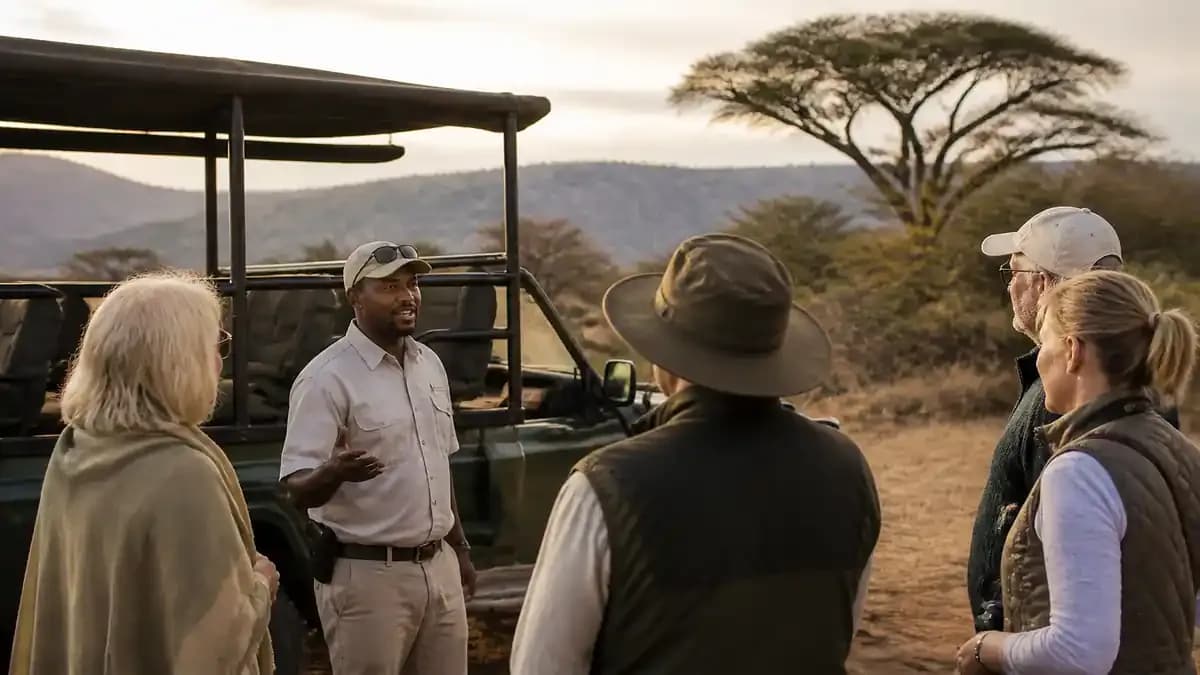
A tourist guide takes visitors around places of interest and tells them what they are seeing. You might walk a group through a museum, lead a township or city tour, explain a heritage site, or take guests on a game drive in a nature reserve. Your job is to keep people safe, informed and happy, so the trip feels special.
Guides usually work in one of three areas: nature, culture or adventure. Some work at one site only, such as a cave or a museum. Others travel across one province or the whole country. Many guides work for themselves and are hired tour by tour, while a smaller group has permanent jobs at parks, museums and attractions.
In South Africa this is a regulated job. Under the Tourism Act, you may not guide people for reward unless you are registered as a tourist guide with a Provincial Registrar. The Act and the tourist guide regulations say that to register, you need a guiding qualification recognised by SAQA and a valid first-aid certificate. Registration lasts three years and then has to be renewed.
A Day in the Life
This is a day for a nature guide at a game lodge. City, museum and site guides start later, but they spend the day the same way: on their feet, hosting guests and telling stories.
04:15
Alarm goes off — In midsummer the alarm can ring at 4:15, and about an hour later in the cooler months. You dress fast, then check the vehicle's oil, water and tyres before any guest appears.
Padkos and coffee — You pack the snack box and the coffee for the morning drive. Then you meet your guests, check everyone has a jacket and a hat, and go through the safety rules for the vehicle.
Morning game drive — The drive leaves around gate opening and lasts about three hours. You track animals, answer questions and explain what guests see. A coffee stop at sunrise is often the moment guests remember most.
Back at the lodge — Guests go to breakfast. You clean the vehicle, fill in your sightings and plan the afternoon drive, which may be for a different group with different interests.
Midday break and study — The hot middle of the day is quieter. Many guides rest, read up on birds, plants or history, or help with lodge duties. Learning never really stops in this job.
Sunset drive — The afternoon drive runs about three hours and comes back after dark. You use a spotlight to look for night animals and keep a close eye on guest safety.
Dinner with guests — You may eat with your guests and answer more questions over dinner. A good evening here often decides how guests rate their whole stay, and whether they tip or come back.
Choose this career if…
- You genuinely like people
- You explain things well
- You can memorise a lot of material
- You keep your cool when someone is rude to you
- You pick up languages easily
- You are fine working nights, weekends and public holidays
- You can handle being away from home for long stretches
Qualification
National Certificate: Tourism: Guiding
Registers you as a Tourist guide
An entry-level guiding qualification, quality assured by CATHSSETA and offered by accredited training providers. SAQA shows the last date to enrol as 30 June 2028.
Regulated under Tourism Act 3 of 2014, s50 and s51; Regulations in respect of Tourist Guides, GN R744 of 17 August 2001 (made under s26 of the repealed Tourism Act 72 of 1993), reg 3(1)(b)(i) · (2001)
SAQA ID 17174 · NQF 2 · 134 credits
Further Education and Training Certificate: Tourist Guiding
Registers you as a Tourist guide
The main guiding qualification, with nature, culture or adventure electives. Much of it is assessed in the workplace. SAQA shows the last date to enrol as 30 June 2028.
Regulated under Tourism Act 3 of 2014, s50 and s51; Regulations in respect of Tourist Guides, GN R744 of 17 August 2001 (made under s26 of the repealed Tourism Act 72 of 1993), reg 3(1)(b)(i) · (2001)
SAQA ID 71549 · NQF 4 · 134 credits
Higher Certificate in Ecotourism Guiding
Registers you as a Tourist guide
A higher-level nature guiding qualification from one private provider, for a career in ecotourism. SAQA shows new students can enrol until 10 July 2029. You still need a current first-aid certificate.
Regulated under Tourism Act 3 of 2014, s50 and s51; Regulations in respect of Tourist Guides, GN R744 of 17 August 2001 (made under s26 of the repealed Tourism Act 72 of 1993), reg 3(1)(b)(i) · (2001)
SAQA ID 119885 · NQF 5 · 120 credits
Two guiding qualifications are being phased out
SAQA registration of the National Certificate and the FETC in guiding ended in 2023, but SAQA shows you can still enrol until 30 June 2028. Ask your provider which qualification you will get.
Salary
Then it grows
Guide, Cango Caves (Oudtshoorn Municipality, T10), with 2 years' guiding experience
R302 000
The advert (closed October 2025) asked for Grade 12, 2 years' relevant experience as a tourist guide, computer literacy, medical fitness and at least two of the three Western Cape official languages.
Work can be insecure
A study published in 2014, of 60 guides surveyed in Gauteng and Mpumalanga in 2010, found two-thirds worked freelance or as temporary staff, so guiding work may be insecure.
- Oudtshoorn Municipality advert, Guide: Cango Caves (salary scale T10), as at September 2025 — as advertised by employers.
Matric Requirements
Pass type you need
- National Certificate: Tourism: Guiding: Matric not required
- Further Education and Training Certificate: Tourist Guiding: Matric not required
- Higher Certificate in Ecotourism Guiding: National Senior Certificate at Higher Certificate level
Mathematics or Maths Literacy?
Worth knowingGrade 10 and 11 · still reversible
Pick Tourism as a subject if your school offers it, and work on your English. Start learning a second language now. Get a first-aid course when you can, and look for weekend or holiday work at a local attraction, museum or lodge to see the job up close.
You take Mathematics
- Every guiding route on this page stays open.
- The Higher Certificate in Ecotourism Guiding stays open, subject to the provider's own entry rules.
- It helps if you later run your own tour business and handle prices and budgets.
You take Mathematical Literacy
- Both the National Certificate and the FETC stay open, because neither asks for school Mathematics.
- The FETC: Tourist Guiding includes Mathematical Literacy as part of the qualification itself.
- For the Higher Certificate in Ecotourism Guiding, check the provider's own entry rules before you choose.
Best School Subjects
Strongly recommended
- Tourism · Covers map work, tour planning, foreign exchange and customer care, which guides use every day.
- English · You explain things to guests all day; Home Language or First Additional Language both work.
Also useful
- History · Helps if you want to guide heritage sites, museums or township and city tours.
- Geography · Helps you read maps, plan routes and explain landscapes and weather.
- Life Sciences · Gives nature guides a head start on plants, animals and ecosystems.
Professional Registration
Registration with the National Department of Tourism (NDT) is compulsory to practise. Under the Tourism Act 3 of 2014.
tourism.gov.za— opens in a new tab · Tourism House, 17 Trevenna Street, Sunnyside, Pretoria
You register in one of these categories:
- Tourist guide
If you guide people for reward, you must apply to a Provincial Registrar of Tourist Guides and pay a registration fee. The National Registrar, in the Department of Tourism, keeps the national database. Registration is valid in every province for three years, and you pay a fee each time you renew it.
Guiding without registration is a crime
Under the Tourism Act, you may not act as a tourist guide for reward unless you are registered. Breaking this rule can mean a fine or up to a year in prison. A business may not employ an unregistered guide either. A company that does this can be fined up to R100,000.
What you need to register
You need a guiding qualification recognised by SAQA and a valid first-aid certificate. You get a badge and an ID card. Some criminal convictions, such as fraud, stop you from registering.
Practical Requirements
Professional driving permit (PrDP) with a criminal record check, before you drive paying guestsClearance or background check
Driving guests for reward on a public road, or driving a bus or any vehicle built for or carrying 12 or more people, including the driver, as driver-guides do. If you drive tourists yourself, you need a professional driving permit as well as your guide registration. You must be at least 21 for a passenger (P) permit and be certified medically fit by a doctor. Your fingerprints are checked against police criminal records, and a conviction, or an admission-of-guilt fine, for driving under the influence of alcohol or drugs, reckless driving, or an offence involving violence, in the five years before you apply stops you from getting the permit.
Required by law · National Road Traffic Act 93 of 1996, s32(1); National Road Traffic Regulations, reg 115(1)(c), (d), (e) and (g), and reg 117
Alternative careers
Related careers. Each has its own entry requirements — check every one separately.
Travel Agent
Plans and books trips from an office, instead of leading the tour in person.
Career Ladder
- Site guide · National Certificate: Tourism: Guiding (NQF 2) or higher, plus registration · NQF 2
- Provincial guide · FETC: Tourist Guiding (NQF 4), plus registration · NQF 4
- National guide · Registered and competent to guide in all nine provinces
- Head guide or senior head guide · At one municipal cave (2026): Grade 12 with N6 Tourism (senior post: or related), guide registration and 2 to 5 years' experience
Where this can lead
Tour Operator
Many experienced guides start their own tour business and guide their own tours.
Guiding among dangerous game takes extra skills
Guiding guests among dangerous game, such as the Big Five, especially on foot, takes extra skills, and you may need firearm proficiency certificates and a licence.
Last reviewed November 2026. We work hard to keep this information accurate, but details can change — always verify before making a career decision. Tell us something is out of date.

