Career profile · Public Service
Fire Fighter
Career summary
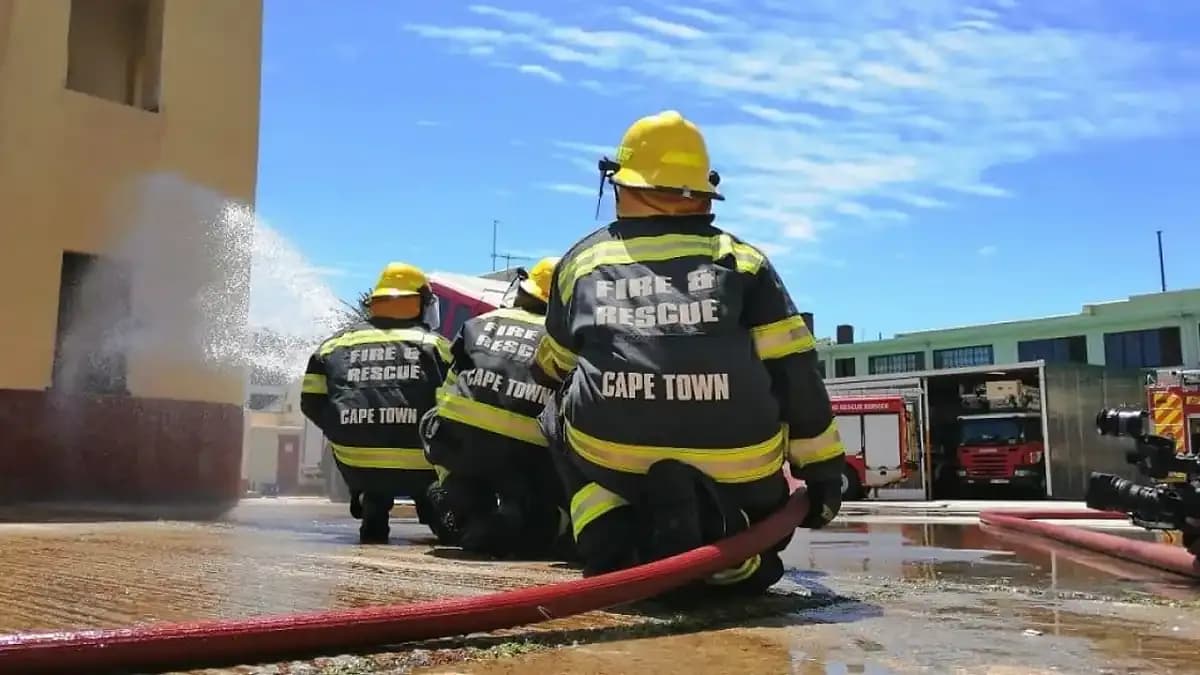
A firefighter's job is to protect people, property and the environment from fire and other emergencies. In South Africa this usually means working for a metropolitan or local municipality's fire and rescue service, responding to structure fires, car accidents, veld fires and chemical spills, often as part of a 24-hour shift.
There is no single national exam or licence you must pass to call yourself a firefighter. Instead, municipalities train and hire their own staff, usually through a paid learnership that combines classroom learning, physical training and real emergency experience, leading to a nationally registered qualification.
It is physically demanding and can be emotionally tough — you will see people on their worst days. But it also comes with a strong sense of purpose and teamwork, and a clear path to move up through the ranks with more experience and further training.
A Day in the Life
A firefighter's day runs in long blocks, not a normal 9-to-5 — many South African fire services work shifts of up to 24 hours in a row, followed by days off.
Shift starts with fitness and gear checks — The crew does physical training, then inspects and cleans all equipment so it is ready for a call at any moment.
Training drills — Between calls, crews drill on ladders, hoses and rescue equipment, often using a training tower at the station.
Call-outs — Structure fires, car crashes needing extrication, veld fires, hazardous chemical spills and medical emergencies can all come in without warning.
Community work — Crews also visit schools to teach fire safety and inspect buildings for fire risks.
Downtime at the station — Between call-outs, crews rest, cook and eat together in the station's shared spaces.
Choose this career if…
- You are physically tough
- You are not squeamish
- You cope well when the plan changes
- You can be trusted with things that matter
- You are fine working nights, weekends and public holidays
- You push through when it gets hard
- You are easy to work alongside
Qualification
- 1year
Occupational Certificate: Firefighter
The main route into municipal firefighting. Delivered as a paid, roughly 12-month learnership at a municipal fire academy (e.g. Cape Town's Cadet Fire Fighter programme).
SAQA ID 98991 · NQF 4 · 149 credits
Working on Fire (wildfire crew programme)
A separate government-funded wildfire (veld and forest fire) programme, not a registered firefighter qualification. It can be a lower-barrier way into fire-related work, but it is a different job to municipal structural firefighting, with very different pay.
Older 'Fire Fighter 1 & 2' certificate names still appear in job ads
Many adverts still ask for 'Fire Fighter 1 & 2' certificates, an older industry-standard name. We could not confirm exactly how these relate to the newer national qualification, so check with the employer directly.
Salary
Then it grows
Working on Fire wildfire crew member — day rate
R122
This is a daily task-based stipend, not an annual salary — deliberately not rounded to the nearest thousand because it is a different pay unit entirely. No experience required to enter.
Chief Fire Officer — Central Karoo District Municipality
R352 000
Gated at 8 years' experience, plus a Certificate in Fire Services Technology
Qualified Fire Fighter — City of Cape Town (higher end found)
R317 000
Gated at minimum 3 years' experience, Fire Fighter 2 certified
Qualified Fire Fighter — Kouga Local Municipality (lower end found)
R190 000
Gated at 2 years' experience, Fire Fighter 1 & 2 certified
Learner Fire Fighter — City of Cape Town (permanent-track entry post)
R199 000
No experience required (Grade 12 only, Mathematics and Physical Science preferred). This is a different, higher-paying permanent-track post to the Cadet Fire Fighter stipend programme above — both are City of Cape Town entry-level posts but they are not the same programme and should not be confused. This dynamic recruitment-portal listing can change; treat as indicative rather than durable.
Cadet Fire Fighter — City of Cape Town
R72 000
No experience required; a monthly training stipend (R5,961.83/month, ref SS 01/25 Ext) converted here to an annual equivalent for comparability — not a fixed annual contract salary. This dynamic recruitment-portal listing can change; treat as indicative rather than durable.
Pay is set city by city
There is no single national firefighter salary. Qualified Fire Fighter posts have advertised anywhere from about R190,000 to R317,000 a year, because each municipality sets its own pay scale; senior management posts pay more on top of that.
Working on Fire is not the same job
Working on Fire pays a small daily stipend for wildfire crews under a government job-creation programme. It is a different, much lower-paid role from a municipal firefighter — don't confuse the two.
Parliamentary Monitoring Group — written reply by the Minister of Forestry, Fisheries and the Environment, 3 Sept 2021, as at September 2021 — basic salary before allowances.Central Karoo District Municipality vacancy notice, as at June 2024 — as advertised by employers.City of Cape Town careers portal — Fire Fighter vacancy (ref SS 09/26 Ext), as at February 2026 — as advertised by employers.Kouga Local Municipality vacancy notice, as at April 2024 — as advertised by employers.City of Cape Town careers portal — Learner Fire Fighter vacancy (ref SS 10/24 Ext), as at April 2024 — as advertised by employers.City of Cape Town careers portal — Cadet Fire Fighter Skills Programme vacancy (ref SS 01/25 Ext), as at September 2026 — basic salary before allowances.
Matric Requirements
Pass type you need
- Occupational Certificate: Firefighter: National Senior Certificate pass
Mathematics or Maths Literacy?
Worth knowingGrade 10 and 11 · still reversible
You take Mathematics
- The main entry route (the Occupational Certificate: Firefighter) lists Maths Literacy as its entry requirement, not Mathematics — Mathematics is a higher-level subject and would not disqualify you, though the SAQA record does not spell out Mathematics as a named alternative.
- It may also help with further study routes like a Fire Technology diploma, though we could not confirm the exact maths requirement those specific programmes set.
- Mathematics can support the more technical side of the job later on, such as hydraulics and hazmat calculations.
You take Mathematical Literacy
- Maths Literacy is explicitly accepted for the main national qualification (Occupational Certificate: Firefighter, NQF Level 4) — this route stays fully open.
- An older, parallel qualification (the Fire and Rescue Operations FET Certificate) also lists Mathematical Literacy as its requirement, not Mathematics.
- We could not confirm whether further-study routes like a Fire Technology diploma require Mathematics instead of Maths Literacy — check with the specific institution before assuming this stays open.
Best School Subjects
Strongly recommended
- Mathematical Literacy · The main national qualification accepts Maths Literacy at NQF Level 4.
- English First Additional Language · Radio communication, reports and safety briefings are in English on most SA fire services.
Also useful
- Physical Sciences · Listed as a preferred (not required) subject on a major municipal cadet programme.
Practical Requirements
Work-integrated learningWork-integrated learning
Entry into municipal fire service employment. This is an employer hiring pathway, not a personal legal registration requirement — no statutory personal register for firefighters exists under South African law. Most new firefighters are trained through a paid, roughly 12-month learnership at a municipal fire and rescue academy, combining classroom learning, physical training and supervised real incident experience. The municipality funds the training; trainees are not expected to pay for it themselves.
Fitness tests and licence rules vary
Each municipality sets its own physical fitness test and decides whether a driving licence is needed at entry level or only for more senior or driving-specific posts.
Career Ladder
- Trainee/Cadet Fire Fighter · Grade 12; not yet holding a firefighting qualification
- Fire Fighter · Occupational Certificate: Firefighter (SAQA 98991) · NQF 4
- Senior/Leading Fire Fighter · Experience plus further certification
- Station Officer · Experience, further training and exams
- Divisional Officer / Assistant Chief Fire Officer · Extensive experience and senior management training
- Chief Fire Officer · Extensive experience, often with a further Fire Technology qualification
We work hard to keep this information accurate, but details can change — always verify before making a career decision. Tell us something is out of date.

