Career profile · Creative
Journalist
Career summary
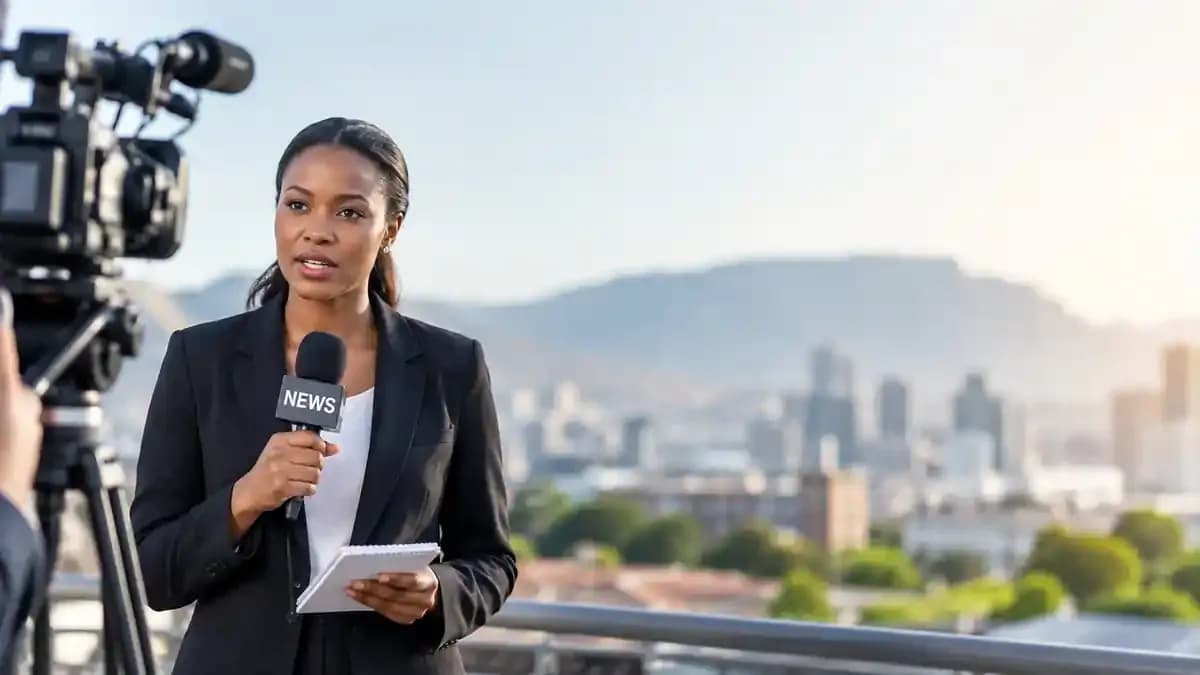
Journalists find out what is happening and tell the public the truth about it. In South Africa, that could mean covering a court case in the morning, a council meeting at lunchtime and a protest before dark. You interview people, check facts, and write or film stories that people can trust.
Many journalists start with a diploma or degree in journalism or media studies, then do an internship in a newsroom. Early on you work as a reporter, learning to find sources and meet deadlines. With experience you can specialise in politics, courts, health or business, or move up to editing and running a newsroom.
This is a tough field to break into. Newsrooms have shrunk, the hours are long, and internships often pay only a stipend. Some journalists face threats, especially online. But the skills travel well: clear writing, research, interviewing and video are valued in government communication, public relations and broadcasting. If you are curious, careful and brave, it can be deeply rewarding.
A Day in the Life
No two days are the same. You chase what is happening today and get it published fast, and it has to be right.
07:00
Check the news — On the bus or at home, you scan news sites, WhatsApp groups, press releases and social media. What happened overnight? What is on today's court roll or council agenda?
08:30
Diary meeting — The news editor runs the morning meeting. You pitch two or three story ideas. You leave with one main story and maybe a short news brief to write too.
09:30
Call your sources — You phone people who know things: police spokespeople, community leaders, officials. You ask for comment and keep following up when nobody picks up. Your contacts list is your most useful tool.
10:30
Go to the scene — You head to a court case, a council meeting or a protest. You take notes, record interviews and shoot phone video, while keeping an eye on your own safety.
13:00
File the first version — Online news cannot wait. You send a short first story from your phone or laptop, then keep adding to it as you learn more.
14:30
Check every fact — You check names, ages, spellings, numbers and quotes. You make sure the other side got a fair chance to reply. One mistake can lead to a complaint against your publication.
15:30
Questions from the desk — An editor asks: "Who said this? Can we prove it?" You fill the gaps. Many newsrooms now have fewer sub-editors, so you check more of your own work.
16:30
Social media — You make a short video or post for the outlet's social pages and reply to readers. Some of them will be rude.
18:00
Deadline, then on call — The final story goes live. If big news breaks tonight, you might be called back in. Weekend shifts usually rotate.
Choose this career if…
- You do not wait to be told
- You are careful with detail
- You read and write well in English
- You can handle being around people who are angry or distressed
- You keep your cool when someone is rude to you
- You are fine working nights, weekends and public holidays
- You can be trusted with things that matter
Qualification
Occupational Certificate: Journalist
A workplace-linked QCTO qualification that includes work experience modules. Its registration has ended, and the last date to enrol is 30 December 2026. Check the provider is QCTO-accredited first.
SAQA ID 101872 · NQF 5 · 193 credits
- 3years
Diploma in Journalism
A hands-on, three-year route offered at some universities of technology and registered private colleges. Some include a work-integrated learning module in a real workplace.
Regulated under Minimum admission requirements for Higher Certificate, Diploma and Bachelor's Degree programmes requiring a National Senior Certificate · GN 751, GG 31231 · (2008)
NQF 6 · 360 credits
- 3years
Bachelor's degree in Journalism (e.g. Bachelor of Journalism or BA with Journalism)
A three-year degree at a university or university of technology. It needs a Bachelor's pass. At the university we checked you also need English at level 5, and you write a selection test and attend an interview. That degree totals 382 credits; credit totals differ by institution, so check each one. It can lead to Honours.
Regulated under Minimum admission requirements for Higher Certificate, Diploma and Bachelor's Degree programmes requiring a National Senior Certificate · GN 751, GG 31231 · (2008), as amended by GN 1369, GG 42100, 14 December 2018 (a near-identical amendment was also published as GN 1309, GG 42068, 30 November 2018)
NQF 7 · 382 credits
- 1year
Advanced Diploma in Journalism
A one-year top-up for people who already have a journalism diploma or a related NQF 6 qualification.
NQF 7 · 120 credits
- 1year
BA Honours in Journalism
One year full-time or two years part-time after a degree. Useful for specialist, research or teaching paths.
NQF 8 · 120 credits
The QCTO Journalist certificate is closing
The Occupational Certificate: Journalist (SAQA 101872) has passed its registration end date. The last date to enrol is 30 December 2026. SAQA's record lists no accredited providers, so check with QCTO before you pay anyone.
Check a private college is registered
Before paying a private college, check that it is on the Department of Higher Education and Training's register of private higher education institutions and that your exact qualification is accredited.
Salary
Deputy Director: Digital Media (GCIS, Level 11)
R932 000
gated at 4 years' relevant experience, including 2 years at Level 9, 10 or an equivalent junior management level
Regional Communication Coordinator: Liaison (GCIS, Level 9) – National Diploma (NQF 6)
R487 000
gated at 3 years' relevant experience, including 1 year at Level 7, 8 or an equivalent supervisory level
Private media pay is not published
Private newsrooms, the SABC and freelancers have no published pay scale. Ask what a job pays, and what it includes, before you accept.
DPSA Public Service Vacancy Circular 17 of 2026 (22 May 2026), GCIS post 17/32, as at April 2026 — total package.DPSA Public Service Vacancy Circular 17 of 2026 (22 May 2026), GCIS posts 17/33–17/34, as at April 2026 — basic salary before allowances.
Matric Requirements
Pass type you need
- Diploma in Journalism: National Senior Certificate at Diploma level
- Bachelor's degree in Journalism (e.g. Bachelor of Journalism or BA with Journalism): National Senior Certificate with a Bachelor’s degree pass
Mathematics or Maths Literacy?
Worth knowingGrade 10 and 11 · still reversible
You take Mathematics
- Every journalism route stays open.
- Data journalism, business and economics reporting are easier to move into.
- You keep the option of switching to a field that needs Mathematics later.
You take Mathematical Literacy
- The journalism diplomas and degrees we checked do not require Mathematics, so Maths Literacy did not close them.
- Rules differ at each institution. Check the exact subject rules of every place you apply to.
- The QCTO Journalist certificate asks for a Level 4 qualification with Communication and Computer Literacy. It does not name a Maths subject.
Best School Subjects
Essential
- English · Courses set a minimum English mark. The universities we checked ask for English at a level and accept either Home Language or First Additional Language.
Also useful
- History · Builds research, argument and understanding of South African politics.
- Mathematical Literacy · Journalists must read budgets, polls and statistics correctly.
Practical Requirements
Newsroom internship after graduating — usually under a yearInternship
Chosen by you after graduating. Employers run these programmes voluntarily; no law requires them. Many newsrooms take graduates as interns before hiring. In 2026 Arena Holdings advertised three 11-month internships with a stipend for journalism or media graduates. Places are few, so apply early and have a portfolio ready.
Work-integrated learning module — one semester in third yearInternship
Part of the diploma itself. It is not required by any law or register. Some journalism diplomas include a work-integrated learning module where you work in a real media workplace. At one university of technology it is a one-semester, 60-credit module in third year. How long it lasts and who finds your placement depends on the institution, so ask before you enrol.
Safety is a real issue
SANEF records physical attacks, threats and online abuse of journalists. It runs a safety programme and mental-health support. Learn how to report an attack before you need to.
Career Ladder
- Newsroom intern · Diploma or degree in journalism or media studies · NQF 6
- Junior reporter · Diploma in Journalism · NQF 6
- Reporter / Journalist · Diploma or Bachelor's degree · NQF 6
- Senior reporter or specialist (politics, courts, business) · Diploma or degree plus experience · NQF 6
- Sub-editor or news editor · Degree or diploma plus years of experience · NQF 6
- Editor / editor-in-chief · Many editors have a degree, plus long experience · NQF 7
Jobs are scarce
Research cited in the Wits Centre for Journalism's State of the Newsroom 2024 estimated that South Africa's journalism workforce fell from over 10,000 in 2008 to about 5,000 in 2018. Some newsrooms have grown since, but big cuts keep happening, such as at Media24 and the Mail & Guardian. Build a portfolio and a backup skill.
We work hard to keep this information accurate, but details can change — always verify before making a career decision. Tell us something is out of date.

