Career profile · Trades
Farrier
Career summary
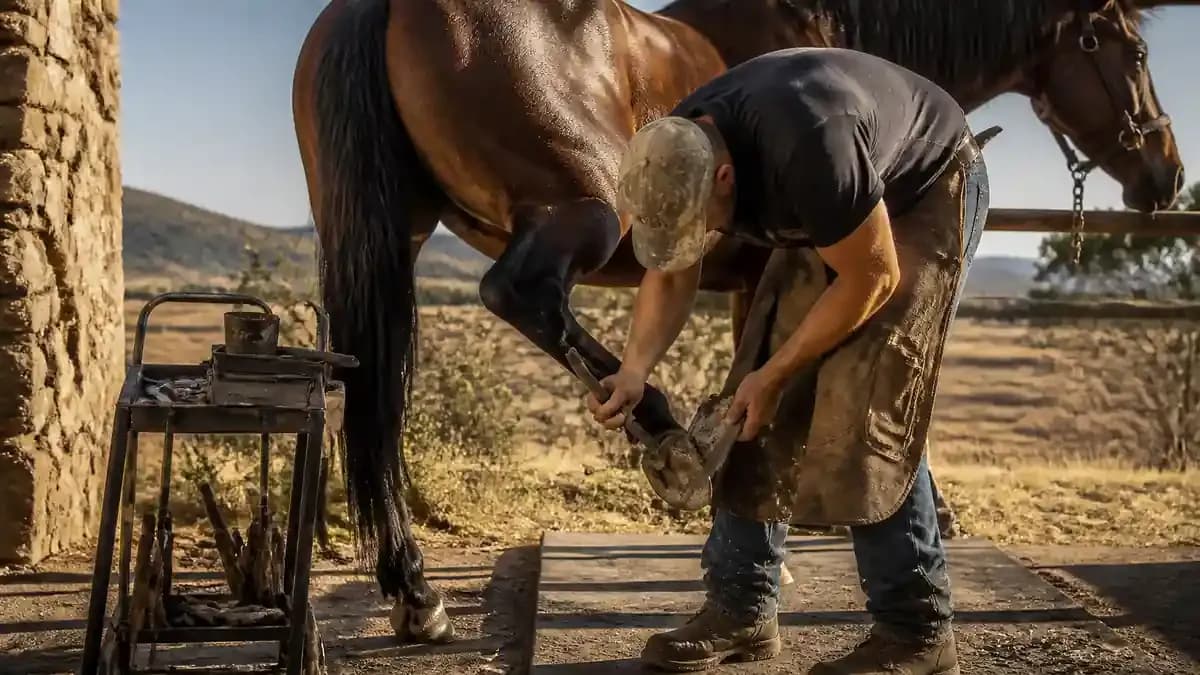
A farrier looks after horses' feet. You inspect each hoof, then trim and shape it. Next you form a metal horseshoe, fit it to the hoof and nail it on. Farriers shoe racehorses and work at racing yards and studs.
In South Africa, the South African Association of Professional Farriers (SAAPF) has said that its recommended way to learn is an apprenticeship with an experienced farrier. It has said the apprenticeship lasts at least three years and ends with an exam. We found no law that says a farrier must register or hold a licence.
One writer called farriery a physical, grubby job. One farrier said, in a Sporting Post profile (last updated 2019), that a stud had flown him in every month for about 12 years. The profile lists that stud among the clients he built up. If you love horses and working with your hands, it can be a proud trade.
A Day in the Life
A farrier's day is a string of hoof jobs, one horse after another, usually at the horse's own yard.
Look, trim and shape — At each horse you check the hoof, trim it and shape a shoe to fit.
Build the shoe — Part of the farrier exam is shoe building and shoe modifications, so you also learn to build and change metal shoes, not only nail them on.
Choose this career if…
- You are steady with your hands
- You are physically tough
- You stay calm when things go wrong
- You do not mind getting dirty
- You can work without someone checking on you
- You are careful with detail
- You prefer practical work to sitting in a lecture
Qualification
- 3years
Apprenticeship with a journeyman farrier, ending in the FITS Certified Farrier exam
Needs a farrier willing to train you. The SAAPF has said the apprenticeship lasts at least three years, then you sit the FITS Certified Farrier exam. We found no published entry rule.
Further Education and Training Certificate: Equine Practices (farriery elective)
SAQA certificate with a farriery elective. Last enrolment 30 June 2028; last date to finish 30 June 2031. Needs at least 160 credits, including 16 in Maths Literacy. Ask a provider if it is offered.
SAQA ID 71469 · NQF 4 · 160 credits
The equine certificates linked to farriery are being phased out
The SAQA certificate we found with farriery electives (Equine Practices, NQF 4) ended its registration on 30 June 2023. SAQA's last date for enrolment is 30 June 2028. A second equine certificate with a hoof-care unit had its last date for enrolment on 30 June 2024. The SAAPF has described an apprenticeship and the FITS exam as another route.
Matric Requirements
Pass type you need
- Apprenticeship with a journeyman farrier, ending in the FITS Certified Farrier exam: Matric not required
- Further Education and Training Certificate: Equine Practices (farriery elective): Matric not required
Mathematics or Maths Literacy?
Worth knowingGrade 10 and 11 · still reversible
Pick the maths subject you can pass, Mathematics or Maths Literacy. Neither closes the farrier routes we found. This week, ask a local farrier, stud or racing yard if you can watch a day of work.
You take Mathematics
- No farrier route we found asks for Mathematics.
- Mathematics keeps other careers and studies open if you change your mind.
- Number skills help with prices, travel costs and bills if you work for yourself.
You take Mathematical Literacy
- The SAQA equine certificate (NQF 4) says it is desirable to start with Maths Literacy at NQF 3, and it includes 16 credits of Maths Literacy at NQF 4.
- The farrier apprenticeship and exam route has no published maths subject rule.
- No farrier route we found closes to Maths Literacy. A training provider's own rules may differ, so ask.
Best School Subjects
Also useful
- Mathematical Literacy · SAQA's equine certificate lists NQF 3 Maths Literacy as desirable and includes 16 Maths Literacy credits at NQF 4.
- Life Sciences · Hoof care training covers hoof condition and problems, so body-science basics help.
- English · The SAQA equine certificate lists communication as a desirable starting point.
Practical Requirements
FITS Certified Farrier exam (three modules, 70% pass mark in each)Requirement
Certification set out by the South African Association of Professional Farriers as part of its recommended programme. We found no law or register category involved. The exam has three modules: theory, shoe building and modifications, and practical trimming and shoeing. You need 70% in each module. FITS examiners must have passed at least the top (Advanced Skills Farrier) level.
Apprenticeship with a journeyman farrier (at least 3 years)Apprenticeship
Not required by any law we found. It is the route the South African Association of Professional Farriers has set out to the FITS Certified Farrier exam. You work hands-on beside an experienced farrier, called a journeyman or training farrier. Theory is mostly self-study. The apprenticeship counts as complete once you pass the FITS Certified Farrier exam.
Training depends on finding a farrier to teach you
The apprenticeship route needs an experienced farrier who is willing to take you on. Start by asking farriers at local yards, studs and racing stables.
Alternative careers
Related careers. Each has its own entry requirements — check every one separately.
Welder
Registers with SAIWAlso shapes metal with heat and tools, but works on structures and machines, not horses' hooves.
Career Ladder
- Apprentice farrier · Apprenticeship of at least three years with a journeyman farrier
- Certified Farrier (CF) · FITS Certified Farrier exam
- Certified Professional Farrier (CPF) · FITS Certified Professional Farrier exam
- Advanced Skills Farrier (ASF) · FITS Advanced Skills Farrier exam
- Farrier with own practice · Own practice (the SAAPF has said this can start from Certified Farrier)
Last reviewed November 2026. We work hard to keep this information accurate, but details can change — always verify before making a career decision. Tell us something is out of date.

