Career profile · Trades
Welder
Career summary
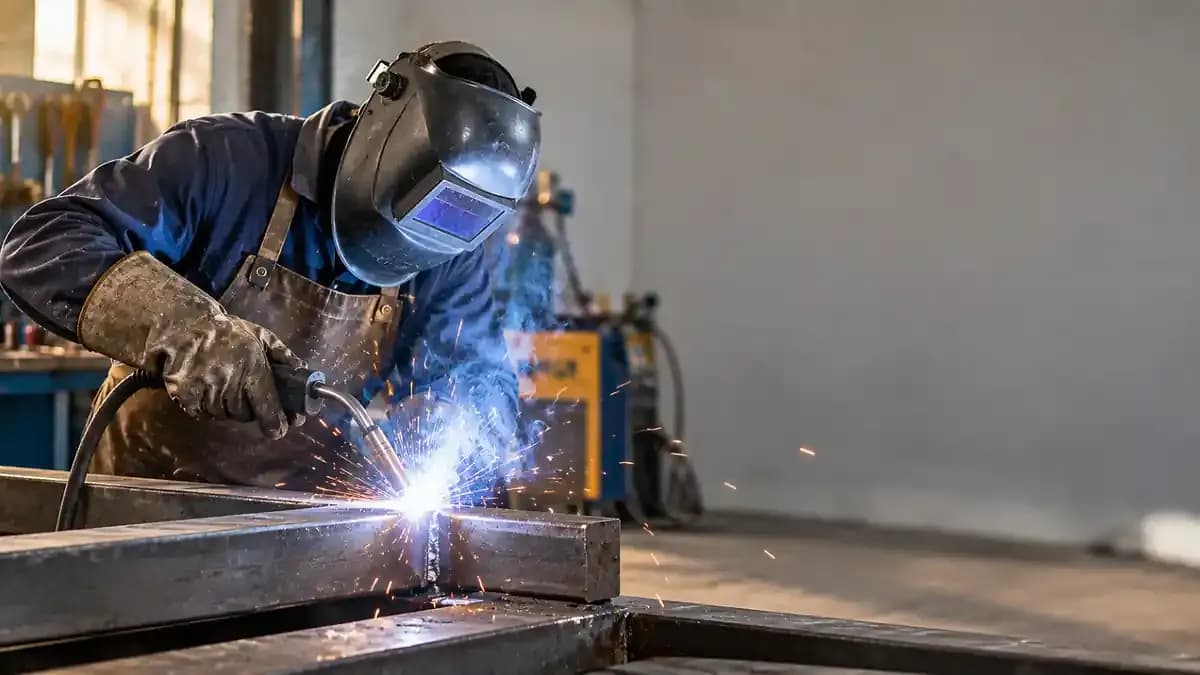
A welder joins pieces of metal by melting them together with an electric arc or a gas flame. In South Africa, welders build steel structures, pipes, tanks, trailers and machine parts, and they repair equipment on mines, farms, power stations and fuel plants. It is skilled, hands-on work where a good weld can hold for decades.
Welding is an official trade in South Africa. Most people qualify through an apprenticeship: you learn at a training centre and at a real workplace, then write a trade test. If you pass, you get a trade certificate and can call yourself a qualified artisan. Many welders also take extra welding tests, called coding, for pipe and pressure work.
Welders work in steel workshops, on mines, at power stations and fuel plants, on building sites and in their own small businesses. The work is hot, noisy and physical, and big plant repairs can take you far from home for weeks. In return you learn a skill used all over the world, and you can grow into inspecting, supervising or running your own shop.
A Day in the Life
Most South African welders work in a steel workshop, but many spend weeks on mines, power stations or fuel plants when big repairs are due. The core of every day is the same: read the drawing, prepare the metal, weld it, and check it.
Safety check first — Before you strike an arc, you check the area. Sparks can fly more than 10 metres, so you move or cover anything that can burn and keep a fire extinguisher close. Then on go the helmet, gloves, protective clothing and safety boots.
Read the drawing — Every job starts with an engineering drawing. It tells you the size of each piece, how the pieces fit together and what kind of weld goes where. Getting this right saves hours of cutting and grinding later.
Cut and prepare the metal — You measure, mark and cut steel plate, pipe or beams, then grind the edges into the right shape so the weld can reach all the way through. Clean, well-prepared metal makes a strong weld.
Lay down the weld — In a workshop you might use MIG or MAG welding on a steel frame. On pipes you might use stick or TIG welding, sometimes in the hardest position, where the pipe is fixed at an angle and you weld all the way around it.
Grind and check your work — You chip off the slag, grind where needed and check your weld with your eyes and measuring tools. Is it the right size? Any cracks, holes or undercut? A welder who checks their own work is worth a lot.
The inspector's visit — On high-pressure pipes and tanks, a welding inspector checks your welds against a written code. Some welds are tested with X-rays or sound waves. If a weld fails, you cut it out and do it again.
Out on site — Some days you are not in the workshop at all. You might weld platforms at a power station, repair structures on a coal mine, or fix a farm trailer. Welders with their own business drive between clients, sites and suppliers.
Shutdown season — When a big plant stops for repairs, it brings in thousands of extra workers for a few weeks. In 2010, a Sasol shutdown at Secunda lasted three weeks and used about 14,500 temporary workers. It is intense work.
Choose this career if…
- You are steady with your hands
- You are careful with detail
- You are physically tough
- You are okay with heights or tight spaces
- You prefer practical work to sitting in a lecture
- You can handle being away from home for long stretches
- You push through when it gets hard
Salary
Then it grows
Artisan Production: Welder, top of the Grade A–C range (Correctional Services advert, 2026)
R424 000
Top of the advertised Grade A–C range. Your grade and pay notch depend on public service rules and your years of experience; the advert does not say how many years this top notch needs.
Artisan Production Grade A: Welder (Correctional Services advert, 2026)
R253 000
Trade Test Certificate underwritten by the Manpower Training Act (Red Seal) and a driver's licence. This is the bottom of the advertised range; your grade and pay notch depend on public service rules and your years of experience.
Apprentice, 4th year (metal and engineering industry minimum, weekly rate × 52)
R229 000
4th year of apprenticeship. A minimum only for employers that belong to the employer bodies that signed the MEIBC agreement, not for others such as NEASA members. Employers could apply to be exempted from the 2026 increase until 31 July 2026.
Apprentice, 1st year (metal and engineering industry minimum, weekly rate × 52)
R124 000
1st year of apprenticeship. A minimum only for employers that belong to the employer bodies that signed the MEIBC agreement, not for others such as NEASA members. Employers could apply to be exempted from the 2026 increase until 31 July 2026.
Pay depends on who you work for
Government pay and metal-industry minimums are published. The metal-industry minimums bind only employers in the bodies that signed the agreement.
DPSA Public Service Vacancy Circular 22 of 2026, Annexure C (Correctional Services), POST 22/14, as at June 2026 — basic salary before allowances.MEIBC Industry Circular 2026/06, as at July 2026 — basic salary before allowances.MEIBC Industry Circular 2026/06 (Main Agreement 1 July 2026 – 30 June 2027), as at July 2026 — basic salary before allowances.
Mathematics or Maths Literacy?
Worth knowingGrade 10 and 11 · still reversible
You take Mathematics
- Mathematics with Physical Sciences keeps more welding paths open, including the IIW International Welding Specialist course, whose first entry option is matric or N3 with maths and science passes (or equivalent) plus two years of related work experience.
- Welders measure, calculate and read drawings every day, so strong maths makes the work itself easier.
- Mathematics with Physical Sciences also covers the 'Mathematics and Science' the welder qualification asks for, with room to spare.
You take Mathematical Literacy
- The Occupational Certificate: Welder asks for Mathematics and Science at NQF Level 1, the level of the school years up to Grade 9. So Maths Literacy in Grades 10 to 12 does not block this route on paper.
- The NQF 2 welding learnership stays open too; it has no matric rule.
- The IIW International Welding Specialist course has a second entry option — Grade 9 plus five years in metalwork — and people with an artisan qualification and experience can ask SAIW about access, so Maths Literacy slows that climb rather than closing it.
Best School Subjects
Strongly recommended
- Mechanical Technology · Its Welding and Metalwork specialisation teaches welding and reading metalwork drawings at school.
- Mathematics · Welders measure and read drawings; supervisor courses ask for maths passes.
Also useful
- Physical Sciences · Helps you understand heat, electricity and how metals behave.
Professional Registration
Registration with the Southern African Institute of Welding (SAIW) is compulsory to practise.
saiw.co.za— opens in a new tab · 52 Western Boulevard, Off Main Reef Road, City West, Johannesburg, 2092
Joining SAIW is your choice. No law says a welder must belong to it, and you can work as a welder without joining. Individual membership is for people with at least five years of welding experience, and there is a separate membership for companies. SAIW charges a membership fee, so ask SAIW for the current amount and how often you pay it.
'Qualified artisan' is a protected title
The Skills Development Act says no one may hold themselves out as qualified as an artisan in a listed trade unless they are registered as an artisan. The register lists people who have an artisan qualification and work in that trade, and the trade test is how you get that qualification. Joining the Southern African Institute of Welding (SAIW) is your choice: no law says a welder must belong to it.
Coded is not the same as trade-tested
A coded welding certificate proves you can make one kind of weld to one standard. The trade test proves you are a qualified artisan. Many jobs ask for both, so check each advert.
Practical Requirements
Coded welding test (to a named standard, e.g. ISO 9606)Requirement
Doing welding that must meet a written code, such as pipes, tanks and pressure equipment. The employer or client, and the standard the job follows, ask for it — not the trade certificate. SAIW's IIW International Welder programme links its training and testing to ISO 9606, the international standard for qualification testing of welders. It has three levels: fillet, plate and pipe. New trainees start with fillet and must pass a practical test before moving up. Experienced welders can start at a higher level if they pass the practical tests for that level and the levels below it.
Welding learnership (158 credits)Work-integrated learning
Choosing to learn welding through a registered learnership. The learnership agreement triggers this, not a register. You, an employer and a training provider sign a learnership agreement registered with a SETA. You learn welding basics at the provider and practise at the workplace. When you finish, you have a national certificate, but you are not yet a qualified artisan. For that you still need the trade test.
Required by law · Skills Development Act 97 of 1998, s17 (learnership agreements)
ARPL assessment and trade test (after at least 3 years of provable work)Requirement
Being 19 or older with at least three years of provable welding work experience but no trade qualification. If you already weld without papers, ARPL lets you prove what you can do. Your experience can come from several employers or from your own customers. You are assessed, do extra training if there are gaps, then write the same trade test as everyone else.
Required by law · Skills Development Act 97 of 1998, s26D(1) read with s26D(2)(c)
Trade test at an accredited trade test centreRequirement
Wanting the artisan qualification for the listed trade Welder. By law, apart from any exemptions the Minister makes, no one may get an artisan qualification without passing a trade test at an accredited trade test centre. After training and workplace experience, you write the trade test at an accredited trade test centre. If you pass, the QCTO issues your trade certificate. Learners get three attempts during their training agreement. If you fail three times, you are referred for recognition of prior learning (RPL).
Required by law · Skills Development Act 97 of 1998, s26D(1); Trade Test Regulations, 2014 (GN R.376, GG 38758, 8 May 2015)
Apprenticeship with workplace training (373 credits, 152 in a workplace)Apprenticeship
Choosing to become a qualified welder (artisan) through the Occupational Certificate: Welder. Welder is a listed trade, so the artisan qualification needs structured workplace training. You learn in a classroom, a welding workshop and a real workplace. You, an employer and an accredited training provider sign an agreement registered with a SETA, and the employer gives you a contract of employment. Of the 373 credits, 152 are workplace experience, covering fillet, plate and pipe welding.
Required by law · Skills Development Act 97 of 1998, s1 ('learnership includes an apprenticeship') and s17, as amended by Act 37 of 2008
Welding can hurt you if safety is skipped
The arc can burn your eyes and skin, fumes can harm your lungs, and electric shock can kill. The law says your employer must train you and give you eye and breathing protection. In a tight or closed space you need good airflow or a mask that supplies clean air. The law says no employer or user of machinery may let anyone weld, cut, grind or solder a tube, tank, drum, vessel or similar container that is completely closed (where pressure could build up dangerously), or that holds something that could catch fire, explode or form dangerous or poisonous substances when heated, until a competent person has examined it and certified in writing that the danger has been removed.
Career Ladder
- Apprentice (learner) welder · Studying the Occupational Certificate: Welder · NQF 4
- Qualified welder (trade-tested artisan) · Occupational Certificate: Welder + trade certificate · NQF 4
- Coded welder (plate or pipe) · Welder qualification test certificate (e.g. to ISO 9606), or IIW International Plate or Pipe Welder
- Welding inspector · SAIW International Welding Inspection Personnel (Basic, Standard, Comprehensive)
- Welding supervisor or coordinator · Experience + IIW International Welding Specialist
- Welding technologist or engineer · National Diploma + IIW International Welding Technologist, or IIW International Welding Engineer
- Own welding or fabrication business · Trade certificate + experience
Last reviewed September 2026. We work hard to keep this information accurate, but details can change — always verify before making a career decision. Tell us something is out of date.

