Career profile · Trades
Boilermaker
Career summary
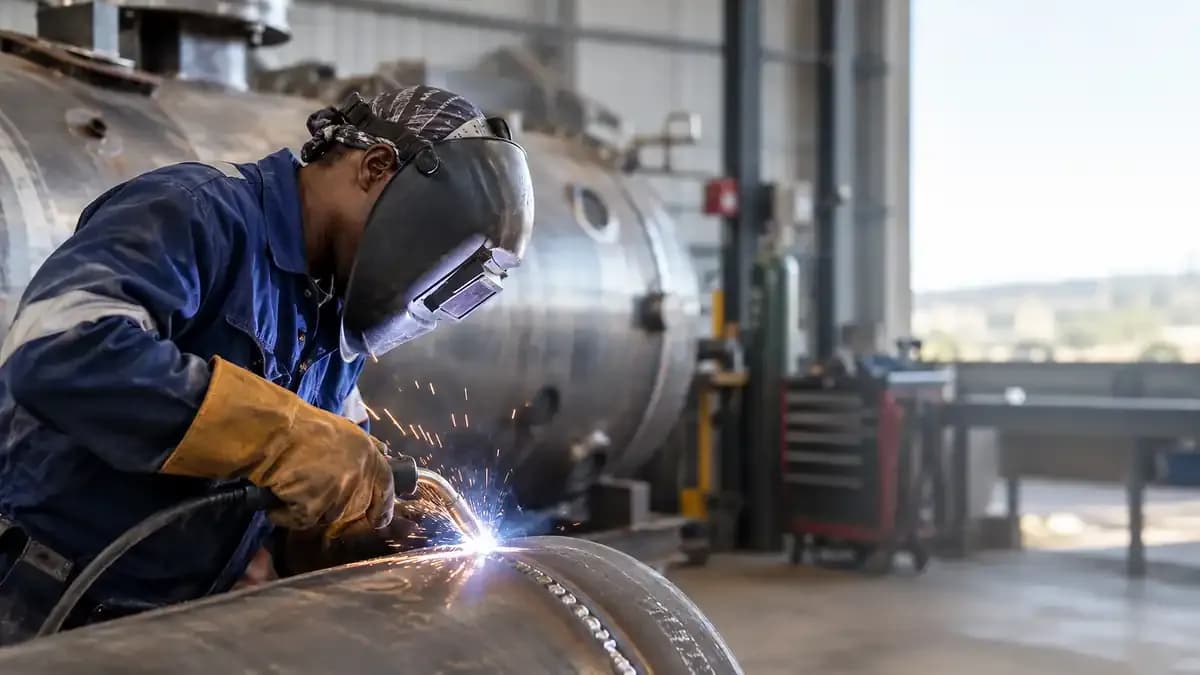
A boilermaker builds and repairs big things made of steel. You read a drawing, mark the shape onto a flat steel plate, cut it, bend it and weld it together. The result might be a tank, a chute in a mine, a steel frame, a pipe system or a pressure vessel in a factory or power station.
Boilermaker is a listed trade in South Africa. That means you qualify by learning at a college and at a real workplace, usually over about three years, and then passing a trade test. Experienced workers who never did a formal apprenticeship can also get to the trade test through recognition of prior learning.
The work is hot, heavy and noisy. You may weld inside tight spaces, high up on steel structures or underground in a mine, and plant shutdowns can mean long shifts away from home. In return you learn a skill that keeps mines, power stations, refineries and factories running, and you can grow into supervising other artisans.
A Day in the Life
A boilermaker's day depends on where you work: a fabrication workshop, a mine, a power station or a plant in shutdown. Most days mix reading drawings, cutting and welding steel, and fitting heavy parts into place.
Read the drawing — The job starts with an engineering drawing. You work out the sizes and angles, then plan how flat steel plate will become a tank, a hopper or a frame.
Mark off and make templates — You mark the shapes onto steel plate and make patterns and templates for curved or angled parts. A mistake here means wasted steel, so you measure twice.
Cut and shape the steel — You cut plate and pipe with gas and other cutting tools, then bend, roll or press it into shape. Heavy pieces are moved with an overhead crane.
Tack and weld — You tack the parts together, check the measurements, then weld the joints. On some jobs an inspector checks the dimensions and welds before the work moves on.
Repair on site — In a mine or plant you may be sent to fix a broken chute, replace worn steel liners or repair a structure. This can mean welding in a confined space, high up, or underground.
Erect and assemble — Finished parts are lifted into position and joined together on site. You work with riggers and fitters to make sure everything lines up and is safe.
Clean up and report — At the end of the job you pack away tools, clear the work area and complete the job card or work order so your supervisor knows what was done.
Choose this career if…
- You are okay with heights or tight spaces
- You are physically tough
- You are steady with your hands
- You are careful with detail
- You like working a problem out logically
- You do not mind getting dirty
- You can handle being away from home for long stretches
Salary
Then it grows
Metal industry minimum, first-year apprentice
R125 000
First year of apprenticeship. Based on the weekly minimum over 52 weeks.
Metal industry minimum, Rate A qualified artisan
R238 000
Qualified artisan (Rate A); no experience gate. Based on the hourly minimum for a 40-hour week.
Artisan Grade C (public service)
R345 000
At least 34 years' experience after the trade test
Artisan Grade B (public service)
R297 000
At least 18 years' experience after the trade test
Artisan Grade A (public service)
R253 000
Trade test certificate; no experience required. The advertised boilermaker post also asked for Grade 12 and a valid driver's licence.
Industry minimums are not average pay
The metal industry figures are the lowest pay allowed at employers that belong to an employers' organisation that signed the bargaining council agreement, unless the council grants an exemption. Employers can pay more, and overtime and shutdown work add to pay. Others are not bound unless the Minister extends it.
MEIBC Industry Circular 2026/06 (4 June 2026), apprentice weekly minimum 1 July 2026 to 30 June 2027, as at July 2026 — basic salary before allowances.MEIBC Industry Circular 2026/06 (4 June 2026), Rate A R114.66/hour from 1 July 2026; boilermaking graded Rate A (Schedule G items 9 and 39) and 40-hour ordinary week (clause 4(1)(a)) from the MEIBC Consolidated Main Agreement 2020/2021, as at July 2026 — basic salary before allowances.DPSA Public Service Vacancy Circular 18 of 2026: POST 18/228 Artisan Grade A–C, R345 342; 34-year gate from POST 18/260 (Artisan Production Grade A to C, Mechanical, Western Cape Health), same circular and same pay, as at May 2026 — as advertised by employers.DPSA Public Service Vacancy Circular 18 of 2026: POST 18/228 Artisan Grade A–C, R297 249; 18-year gate from POST 18/260 (Artisan Production Grade A to C, Mechanical, Western Cape Health), same circular and same pay, as at May 2026 — as advertised by employers.DPSA Public Service Vacancy Circular 18 of 2026: POST 18/228 Artisan Grade A–C (Boiler Maker among listed trades), Northern Cape Health, R253 341 and requirements; 'no experience required' from POST 18/260 (Artisan Production Grade A to C, Mechanical, Western Cape Health), same circular and same pay, as at May 2026 — as advertised by employers.
Mathematics or Maths Literacy?
Worth knowingGrade 10 and 11 · still reversible
You take Mathematics
- Every boilermaker route stays open: the occupational certificate, apprenticeships and ARPL.
- Learner programmes at big employers that ask for Mathematics or Technical Mathematics stay open.
- Further study towards a supervisor or engineering diploma later stays easier.
You take Mathematical Literacy
- The SAQA entry rule is an NQF Level 1 qualification with mathematics. It does not mention Maths Literacy, so ask the college whether your results meet it.
- Some employer learner programmes list only Mathematics or Technical Mathematics, so you may have fewer apprenticeship offers.
- College placement tests can still check your numeracy before you start.
Best School Subjects
Strongly recommended
- Mathematics · SAQA 123381 asks for an NQF Level 1 qualification with mathematics; the older SAQA 93626 adds science.
- Technical Mathematics · Accepted by some employers in place of Mathematics for artisan learner programmes.
- Physical Sciences · Helps with heat, forces and materials, and some employers ask for it.
- Engineering Graphics and Design · Boilermakers read engineering drawings and develop patterns from them every day.
Also useful
- Technical Sciences · A technical-school alternative to Physical Sciences.
- Mechanical Technology · The Welding and Metalwork option teaches the same basic skills.
Practical Requirements
Trade test at an accredited trade test centreRequirement
Wanting the artisan qualification (trade certificate) in the listed trade Boiler Maker To become a qualified boilermaker you must pass a trade test at a centre accredited by the QCTO. You can apply after an apprenticeship, a learnership, another qualifying programme with work experience, or recognition of prior learning. When you pass, the QCTO issues your trade certificate.
Required by law · Skills Development Act 97 of 1998, s26D(1)
About three years of college and workplace learningApprenticeship
Enrolling for the National Occupational Certificate: Boilermaker The qualification has knowledge, practical and workplace parts. The workplace part covers five modules: patterns and templates, tools and machines, cutting and welding, fabrication and repair, and erecting structures. You build a portfolio of evidence from real work. SAQA says the qualification is usually completed within three years.
Three tries at the trade test
If you are on a learning programme agreement, such as an apprenticeship, you get three attempts at the trade test during that agreement. If you still do not pass, you are referred for recognition of prior learning.
Alternative careers
Related careers. Each has its own entry requirements — check every one separately.
Welder
Registers with SAIWSpecialises in joining metal; boilermakers also mark off, cut, shape and erect whole structures.
Career Ladder
- Apprentice boilermaker · Studying the National Occupational Certificate: Boilermaker
- Boilermaker (qualified artisan) · Trade certificate after passing the trade test · NQF 4
- Artisan foreman · Trade certificate + experience as an artisan
- Chief artisan · Trade certificate + experience as an artisan or foreman
- Welding inspector · Experience + welding inspection training
Last reviewed October 2026. We work hard to keep this information accurate, but details can change — always verify before making a career decision. Tell us something is out of date.

