Career profile · Agriculture
Wine Maker
Career summary
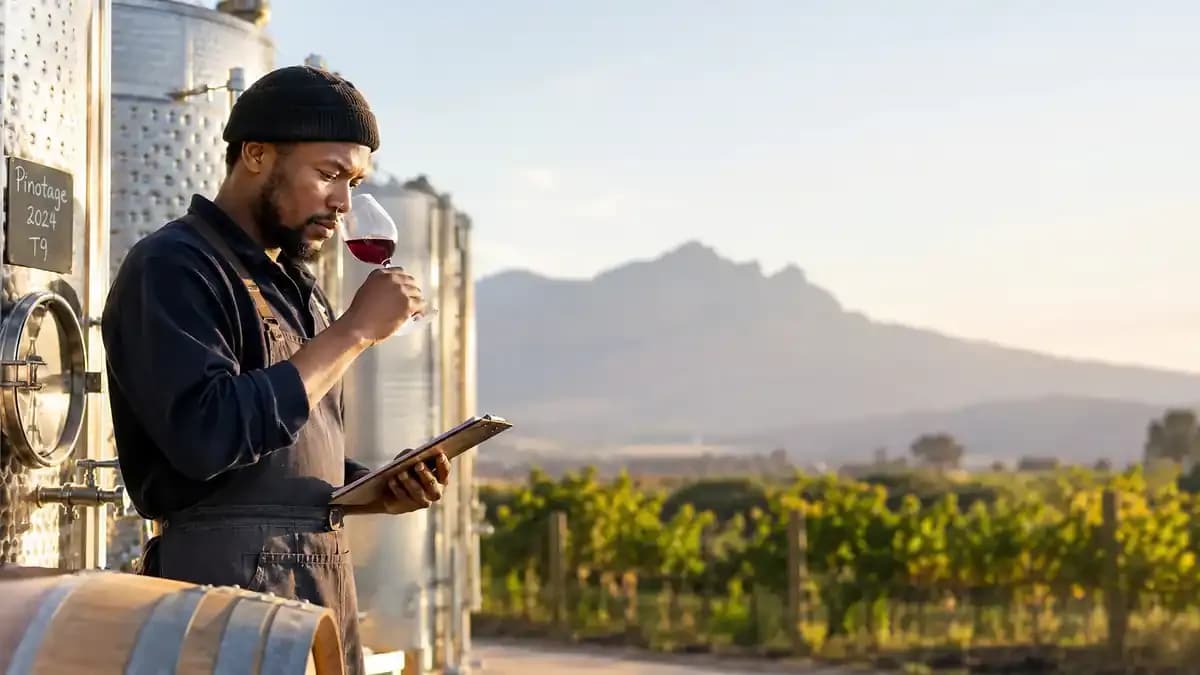
A wine maker decides how grapes become wine. They check when grapes are ripe, guide the crushing and pressing, and watch the tanks and barrels while the juice ferments. They taste, test and blend the wine until it is ready to bottle. It is part science, part farming and part craft.
Many wine makers in South Africa work in the Western Cape winelands. Some work at private wine farms, some at producer cellars that press grapes for many farmers, and some at big wine companies. A wine maker often leads a small cellar team and works closely with the people who grow the grapes.
The job changes with the seasons. Harvest, roughly late January to March or early April, is fast and exhausting, with very early starts and late nights. The rest of the year is calmer, with barrel care, blending, bottling, record-keeping and showing wines to buyers. Many people start as a cellar hand or intern and work their way up.
A Day in the Life
A wine maker's day depends on the season. During harvest it is long, loud and physical. The rest of the year it is slower and more about tasting, testing and planning.
05:00
Early start in harvest — In harvest season some wine makers start at 5am. Grapes are picked in the cool early morning, so the cellar must be ready before the first loads arrive.
07:00
Grapes arrive — Trucks and trailers bring in the grapes. The wine maker checks their ripeness and condition, then decides how they will be crushed or pressed and which tank they go into.
Checking every ferment — Through the day the wine maker tastes and tests the tanks and barrels. Sugar and acidity (pH) are measured, and a fermentation that slows down needs attention.
Cleaning, again and again — Tanks, hoses, presses and floors are cleaned all the time to keep the wine safe. Cleaning takes up a big part of the day.
Late finish — On busy harvest days the team may only go home long after dark.
The quieter months — After harvest the work moves to racking, barrel care, blending, filtering and bottling. There are records to keep for industry audits, stock to count, and wine shows, tastings and visitors to host.
Choose this career if…
- You are physically tough
- You are fine working nights, weekends and public holidays
- You do not mind getting dirty
- You are careful with detail
- You cope well when the plan changes
- You like working a problem out logically
- You are comfortable with numbers
Salary
No published pay scale
We found no official or public industry pay scale for wine makers in South Africa, so this page does not show a salary figure. Pay is agreed with each employer.
Mathematics or Maths Literacy?
Worth knowingGrade 10 and 11 · still reversible
You take Mathematics
- With at least 60% for Mathematics, you can apply for the four-year degree, as long as you also get at least 50% for Physical Sciences and for English or Afrikaans (Home Language or First Additional Language), and an average of 60% or more (not counting Life Orientation). These marks do not guarantee a place.
- You can later move into wine chemistry, laboratory or research work.
- You will find the lab work and readings in the cellar easier.
You take Mathematical Literacy
- The four-year science degree in viticulture and oenology closes, because it requires Mathematics.
- The three-year Diploma in Agriculture with cellar technology stays open, but asks for a higher Maths Literacy mark than the Mathematics mark.
- You can still start as a cellar hand and learn on the job, but moving up to wine maker without a qualification is hard.
Best School Subjects
Strongly recommended
- Mathematics · Required for the degree. The diploma accepts Maths Literacy instead, at a higher mark.
- Physical Sciences · Required for the degree; winemaking is applied chemistry. The diploma accepts Life or Agricultural Sciences instead.
- Life Sciences · Accepted for the diploma route and helps with yeast, vine and microbe topics.
Also useful
- Agricultural Sciences · Accepted as a science for the diploma route and builds farming knowledge.
Practical Requirements
Final-year cellar work placement (diploma)Internship
Reaching the final year of the diploma in the cellar technology field. Diploma students in cellar technology complete a work-integrated learning component in their final year. It covers judging grape ripeness and quality, harvesting methods and separating the juice from the skins. Students must make sure they are placed at a suitable farming business.
Vineyard and cellar internship (end of 3rd year to middle of 4th year of degree)Internship
Passing 10 set grapevine and wine science modules of the BScAgric (Viticulture and Oenology majors). The training is compulsory and usually runs from the end of third year. Degree students spend the end of their third year and the first part of their final year working in industry. They prune vines in winter, look after the leaves and shoots in summer and work in a commercial wine cellar, under academic and industry mentors. They also run a project, write a report and present it.
Career Ladder
- Cellar assistant (cellar hand) · No formal qualification; learnt on the job
- Harvest intern · Final-year degree or diploma student
- Assistant wine maker · Degree or diploma in viticulture and oenology or cellar technology, plus cellar experience
- Wine maker · Degree or diploma in viticulture and oenology or cellar technology, plus winemaking experience
- Cellarmaster (head wine maker) · Degree or diploma plus winemaking experience
Last reviewed October 2026. We work hard to keep this information accurate, but details can change — always verify before making a career decision. Tell us something is out of date.

