Career profile · Creative
Sound Engineer
Career summary
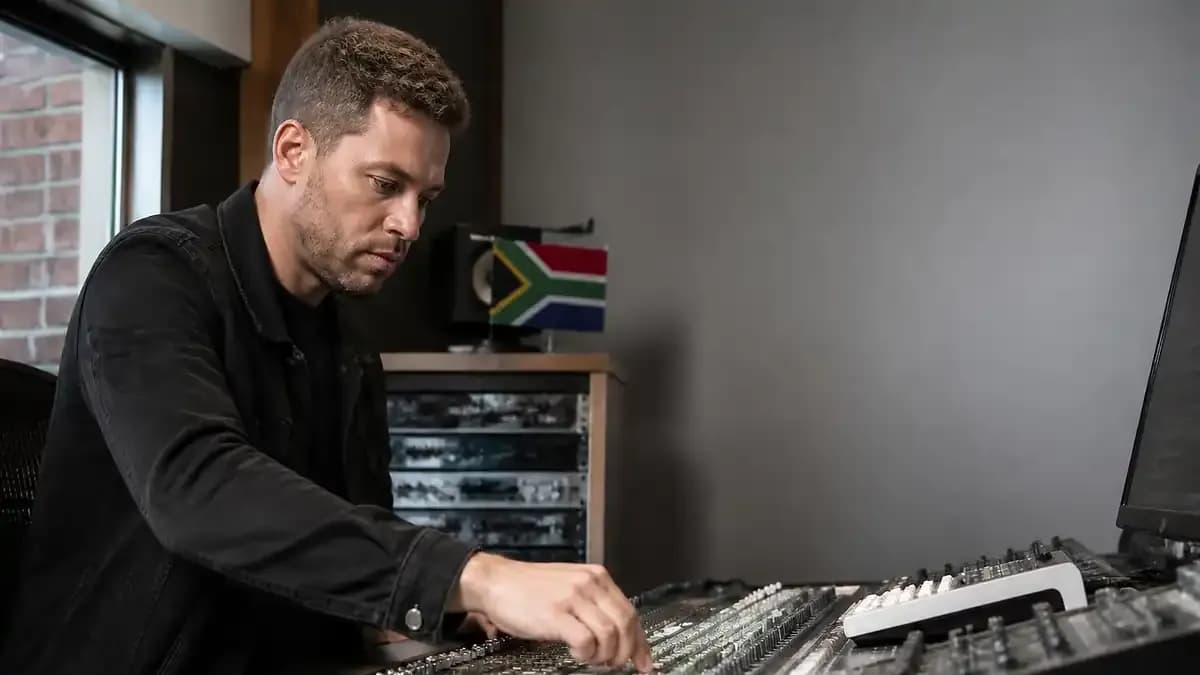
A sound engineer makes sure the audience hears exactly what they should. At a concert you balance every microphone and instrument through a mixing desk. In a studio you record musicians and shape the final song. In radio, TV and film you capture clean dialogue, add effects and mix it all so it sounds right on any speaker.
The work is part creative, part technical. You need good ears and a feel for music, but you also need to understand cables, microphones, speakers and computer software. When something hums, crackles or goes silent in the middle of a show, you are the person who finds the fault and fixes it quickly and calmly.
Most people start as an assistant or crew member, carrying gear and learning from experienced engineers. Many sound engineers in South Africa work freelance, moving from gig to gig, while others work shifts at broadcasters or theatres. With experience you can move into mixing, mastering, post-production for film, technical management or running your own studio.
A Day in the Life
This is a show day for a sound engineer working in a theatre or at a live event. It is long, loud and physical, and it only ends when the last case is packed away.
10:00
Production meeting — You sit down with the stage manager and the show's team. You go through what the performance needs: how many microphones, what the performers need to hear on stage, and any music or sound effects that must play on cue.
11:30
Get-in and rigging — The gear arrives. You carry and set up speakers, run cables across the stage and connect everything to the mixing desk. Anything hung above the audience gets checked and fitted with a safety cable.
14:00
Line check — You test every microphone and every channel on the desk, one at a time. A dead channel usually means a faulty cable or a wrong connection, and you track it down before the artists arrive.
16:00
Soundcheck with the artists — The performers play while you set levels and tone for each voice and instrument. Musicians ask for changes in their monitors, and you make them quickly and calmly so the band stays relaxed.
18:30
Break and final prep — You save the show settings on the desk, grab something to eat and brief the stage manager on any changes. You check your spare microphones and batteries are ready in case something fails.
19:30
The show — You mix the sound live from the desk in the audience. You ride the levels as songs change, bring in cues on time, and fix any problem in seconds without the audience noticing.
22:30
Strike and pack down — When the audience leaves, you take everything apart, coil the cables and pack the gear safely into cases. You note any faulty equipment so it can be repaired before the next show.
Choose this career if…
- You stay calm when things go wrong
- You are careful with detail
- You like working a problem out logically
- You are fine working nights, weekends and public holidays
- You are physically tough
- You are easy to work alongside
Qualification
- 1year
Higher Certificate in sound technology or sound production
Registers you as a Certified BCT Practitioner
A one-year starting course. Each college registers its own qualification with SAQA, so the SAQA ID differs between colleges.
SAQA ID 118926 · NQF 5 · 120 credits
Higher Occupational Certificate: Sound Operator
Registers you as a Certified TLE Practitioner
A national occupational qualification with a 40-credit work experience module. Entry is any NQF level 4 qualification, such as a matric. SAQA lists no accredited providers yet.
SAQA ID 120748 · NQF 5 · 168 credits
- 3years
Diploma in sound technology or audio technology
A deeper course in recording, live sound and post-production, offered by private colleges. Each college registers its own qualification, so SAQA IDs differ.
SAQA ID 88262 · NQF 6 · 360 credits
- 3years
Bachelor's degree in sound production or sound technology
A three-year degree for studio, film, TV and live sound careers. Needs a bachelor's pass. Each institution registers its own degree, so SAQA IDs differ.
SAQA ID 90673 · NQF 7 · 360 credits
Check the college is registered
Many sound courses are offered by private colleges. Before you pay, check that the college is registered with the Department of Higher Education and Training, or accredited by the QCTO for occupational certificates, and that the qualification is on the SAQA register. NSFAS only funds study at public universities and public TVET colleges.
The Sound Operator certificate is new
The Higher Occupational Certificate: Sound Operator was registered in 2023. In October 2026 SAQA listed no accredited providers for it, so ask any provider to show proof of accreditation before you enrol.
Salary
You will often be a freelancer
Many sound engineers work gig to gig as freelancers rather than as employees. That usually means no paid leave, and nobody takes tax off your pay for you.
Matric Requirements
Pass type you need
- Higher Certificate in sound technology or sound production: National Senior Certificate at Higher Certificate level
- Higher Occupational Certificate: Sound Operator: National Senior Certificate pass
- Diploma in sound technology or audio technology: National Senior Certificate at Diploma level
- Bachelor's degree in sound production or sound technology: National Senior Certificate with a Bachelor’s degree pass
Mathematics or Maths Literacy?
Worth knowingGrade 10 and 11 · still reversible
You take Mathematics
- Taking Mathematics does not close any route on this page.
- You will find the technical theory of signals, levels and electronics easier.
You take Mathematical Literacy
- Higher certificate courses in sound production that state "Maths or Maths Literacy" stay open to you.
- Some diploma and degree courses do not name any school subjects, only the type of matric pass, so check each course's rules before you apply.
- Any university programme that requires Mathematics as a school subject will be closed.
Best School Subjects
Essential
- English · Sound courses ask for English. Home Language or First Additional Language are both accepted.
Strongly recommended
- Music · At least one sound production higher certificate expects basic music knowledge and teaches music theory.
Also useful
- Mathematics · Helps with technical theory. Many sound courses accept Mathematical Literacy instead.
- Mathematical Literacy · Accepted for many higher certificate courses in sound. Check each course before you choose.
- Computer Applications Technology · Sound courses expect computer literacy, and the work runs on recording software.
Professional Registration
This career is associated with the Southern African Communications Industries Association (SACIA).
96 The Bridles, 777 Douglas Crescent, Sundowner, 2188
You register in one of these categories:
- Certified BCT Practitioner
- Certified TLE Practitioner
Voluntary. Once-off registration R575, then each year: membership R575 plus a certification fee of R1,150 (Associate), R1,610 (Practitioner) or R2,070 (Professional). All prices include VAT. SACIA’s site doesn’t say which year these are for.
No licence or register for sound engineers
South Africa has no legal register for sound engineers, and you do not need a licence to do the work. Employers look at your training, your experience and examples of your work. The Southern African Communications Industries Association (SACIA) offers voluntary professional designations for live events, broadcast and audio-visual work. They are not a licence to work.
Practical Requirements
Work experience module inside the Sound Operator certificate (40 credits)Internship
Enrolling for the Higher Occupational Certificate: Sound Operator. Proof of the work experience is needed before you can sit the final external assessment. This qualification includes a work experience module, worth 40 credits, in either live events or recorded events. You must show a statement of work experience, along with your other results, before you can sit the final national assessment. The qualification does not say how many weeks this takes or who pays for it, so ask the training provider.
Protect your hearing
Loud sound can damage your hearing for good. In a small South African study, sound engineers often reported ringing ears. The law's noise-rating limit is 85 dBA, averaged over an 8-hour day. Employers and self-employed people must mark areas at or above it as noise zones. Employers must not let anyone enter or stay there without correctly worn hearing protection.
Career Ladder
- Studio Assistant or Live Sound Assistant · Higher Certificate in sound production · NQF 5
- Sound Operator or Technical Operator · Higher Certificate in sound plus experience, or the Higher Occupational Certificate: Sound Operator · NQF 5
- Sound Engineer (studio, live or post-production) · A sound certificate plus experience, or a diploma or degree in sound technology or production · NQF 5
- Senior Engineer, Mix Engineer or Mastering Engineer · Several years of experience
- Chief Engineer, Head of Technical or Studio Owner · Experience and a strong portfolio
Last reviewed October 2026. We work hard to keep this information accurate, but details can change — always verify before making a career decision. Tell us something is out of date.

