Career profile · Health
Radiographer
Career summary
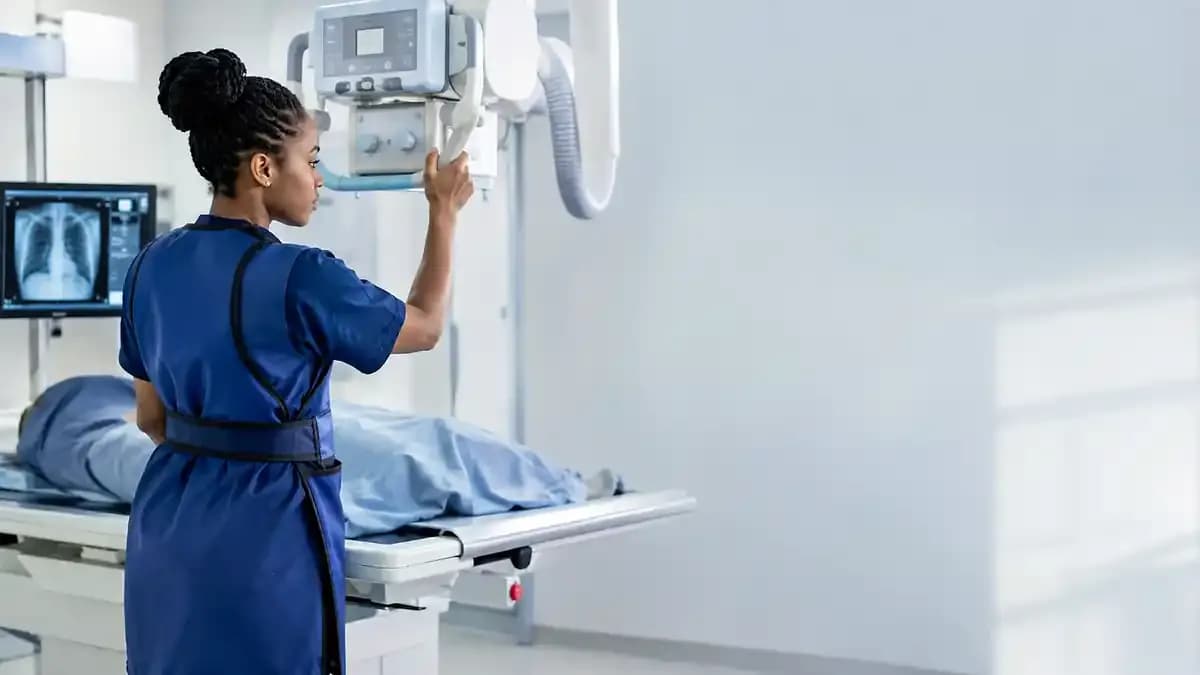
A radiographer is the health professional who makes the pictures of the inside of your body. When someone breaks an arm, has a bad cough or is hurt in a car crash, a radiographer takes the X-ray or scan that shows the doctor what is wrong. Other radiographers use radiation to treat cancer.
In South Africa there are four main kinds of radiographer. Diagnostic radiographers do X-rays and scans. Sonographers use sound waves to make images, for example of a baby before birth. Nuclear medicine radiographers use tiny amounts of radioactive medicine. Radiation therapists aim strong radiation at cancer cells. You usually choose one of the four when you apply to study.
To become a radiographer you need a four-year university degree in your chosen kind of radiography. You register with the Health Professions Council of South Africa as a student while you study. After you graduate you do one year of paid community service, usually in a public hospital, before you can register to work in public or private practice.
A Day in the Life
This is a typical day for a diagnostic radiographer in a South African public hospital, such as someone in their community-service year. Sonographers, nuclear medicine radiographers and radiation therapists work more to a booked list of patients, with fewer emergencies.
07:00
Handover and checks — You hear from the night shift what happened, check that the X-ray rooms and machines are working, and clip on your radiation badge. Every radiation worker wears one so their dose can be measured.
08:00
Casualty X-rays — Patients arrive from casualty after falls, fights and car crashes. You position each one carefully, even when they are in pain, choose the right angle and settings, and get a clear image first time so the doctor can act fast.
10:00
Outpatient list — Chest X-rays, knees, spines and hands. Many patients are nervous or don't know what will happen, so you explain each step simply and make sure you have the right patient and the right body part.
11:30
Ward and ICU rounds — Some patients are too sick to move. You wheel a portable X-ray machine to the wards and ICU, wear a lead apron, and help nurses lift and turn patients so you can place the plate under them.
13:00
Theatre — In the operating theatre you run a mobile X-ray unit that shows live images while surgeons fix broken bones. You follow theatre rules and keep everyone safe from unnecessary radiation.
14:30
Special examinations — You may rotate through fluoroscopy, CT or MRI, working alongside a radiologist. The radiologist, a specialist doctor, reads the images and writes the report.
16:00
Records and hand over — You check that every image is sent and labelled correctly, record doses and the day's work, and hand over to the next shift.
After hours
On call — Hospitals need X-rays 24 hours a day. You take your turn on the after-hours roster, covering casualty and emergencies at night, on weekends and on public holidays.
Choose this career if…
- You are careful with detail
- You are physically tough
- You are fine working nights, weekends and public holidays
- You stay calm when things go wrong
- You explain things well
- You are comfortable with numbers
- You are not squeamish
Salary
Then it grows
Ultrasound Radiographer (Sonographer) Grade 3 (public service)
R704 000
This advert asked for at least 20 years' experience after registration (21 years if you qualified outside South Africa and did not have to do community service).
Ultrasound Radiographer (Sonographer) Grade 2 (public service)
R598 000
This advert asked for at least 10 years' experience after registration (11 years if you qualified outside South Africa and did not have to do community service).
Ultrasound Radiographer (Sonographer) Grade 1 (public service)
R511 000
No experience needed after registering with the HPCSA in ultrasound, if you qualified in South Africa and did community service.
Nuclear Medicine Radiographer Grade 3 (public service)
R704 000
This advert asked for at least 20 years' experience after registration (21 years if you qualified outside South Africa and did not have to do community service).
Nuclear Medicine Radiographer Grade 2 (public service)
R598 000
This advert asked for at least 10 years' experience after registration (11 years if you qualified outside South Africa and did not have to do community service).
Nuclear Medicine Radiographer Grade 1 (public service)
R511 000
No experience needed after registering with the HPCSA in nuclear medicine, if you qualified in South Africa. Foreign-qualified: 1 year's experience after registration.
Radiation Oncology Radiographer Grade 3 (public service)
R704 000
This advert does not say how many years of experience each grade needs.
Radiation Oncology Radiographer Grade 2 (public service)
R598 000
This advert does not say how many years of experience each grade needs.
Radiation Oncology Radiographer Grade 1 (public service)
R511 000
This advert does not say how many years of experience each grade needs.
Diagnostic Radiographer Grade 3 (public service)
R565 000
This advert asked for at least 20 years' relevant experience after registration (21 years if you qualified outside South Africa and did not have to do community service).
Diagnostic Radiographer Grade 2 (public service)
R482 000
This advert asked for at least 10 years' relevant experience after registration (11 years if you qualified outside South Africa and did not have to do community service).
Diagnostic Radiographer Grade 1 (public service)
R413 000
No experience needed after registering with the HPCSA as a Diagnostic Radiographer, if you qualified in South Africa and did community service. Foreign-qualified: 1 year's experience after registration.
Two government pay scales
In government, sonographers, radiation therapists and nuclear medicine radiographers start on a higher pay scale than diagnostic radiographers. In the adverts we read that list experience, Grade 2 needed at least 10 years after registration and Grade 3 at least 20 (11 and 21 if you qualified outside South Africa and did not have to do community service).
DPSA Public Service Vacancy Circular 28 of 2026, Annexure T, KwaZulu-Natal Health, POST 28/97 Ultra-Sonographer, ref DANCHC 06/2026; other benefits 13th cheque, medical aid (optional), rural and housing allowance. Effective date: DPSA letter 14/2/1/1/4 of 27 Mar 2026 (Circular 15 of 2026): 4% cost-of-living adjustment from 1 April 2026, incl. the OSD for Therapeutic, Diagnostic and other Allied Health Professionals, as at April 2026 — basic salary before allowances.DPSA Public Service Vacancy Circular 29 of 2026 (14 Aug 2026), Annexure V, Western Cape Health and Wellness, POST 29/282 Radiographer Grade 1 to 3 (Nuclear Medicine), Groote Schuur Hospital. Effective date: DPSA letter 14/2/1/1/4 of 27 Mar 2026 (Circular 15 of 2026): 4% cost-of-living adjustment from 1 April 2026, incl. the OSD for Therapeutic, Diagnostic and other Allied Health Professionals, as at April 2026 — as advertised by employers.DPSA Public Service Vacancy Circular 20 of 2026 (12 Jun 2026), Annexure X, KwaZulu-Natal Health, POST 20/147 Radiation Oncology Radiographer (Radiotherapist), ref RADRADIOONCO/1/2026; salary quoted plus 13th cheque, medical aid (optional) and housing allowance. Effective date: DPSA letter 14/2/1/1/4 of 27 Mar 2026 (Circular 15 of 2026): 4% cost-of-living adjustment from 1 April 2026, incl. the OSD for Therapeutic, Diagnostic and other Allied Health Professionals, as at April 2026 — basic salary before allowances.DPSA Public Service Vacancy Circular 29 of 2026 (14 Aug 2026), Annexure V, Western Cape Health and Wellness, POST 29/284 Radiographer Grade 1 to 3 (Diagnostic), Tygerberg Hospital. Effective date: DPSA letter 14/2/1/1/4 of 27 Mar 2026 (Circular 15 of 2026): 4% cost-of-living adjustment from 1 April 2026, incl. the OSD for Therapeutic, Diagnostic and other Allied Health Professionals, as at April 2026 — as advertised by employers.
Mathematics or Maths Literacy?
Decide nowGrade 10 and 11 · still reversible
You take Mathematics
- Mathematics keeps all four kinds of radiography open to you, as long as you also meet the other subject requirements, especially Physical Sciences.
- Mathematics is accepted at every university we checked that offers radiography, if you get the required mark (usually level 4, 50% or more).
- Maths also helps with the physics you study in first year.
You take Mathematical Literacy
- All four radiography degrees close. No university we checked accepts Mathematical Literacy for any of them.
- Clinical technology, a related career, also asked for Mathematics at the university we checked.
Best School Subjects
Essential
- Mathematics · Every radiography degree we checked asks for it. None accepts Maths Literacy.
- Physical Sciences · Radiography is built on physics. Almost every radiography degree we checked asks for it.
Strongly recommended
- Life Sciences · Most radiography degrees we checked require it, and it helps with anatomy.
- English · Most universities we checked set a minimum English mark.
Professional Registration
Registration with the Health Professions Council of South Africa (HPCSA) is compulsory to practise. Under the Health Professions Act 56 of 1974 (s15 boards; s17 registration required to practise; s18-19 registers/removal; s39 offence to practise unregistered).
hpcsa.co.za— opens in a new tab · 553 Hamilton and Madiba Streets, Arcadia, Pretoria, 0002
Annual fee required to remain on the register; non-payment leads to removal (s19). No amount stated.
Health Professions Council of South Africa— opens in a new tab
You register in a category, and can add more
You register in one or more categories: diagnosis, therapy, nuclear medicine or ultrasound. To add another, you need a recognised qualification in that category, and then you may apply to register it too.
The scope rules are old
The HPCSA still lists rules from 1976 as the ones that describe what radiographers may do. New draft rules were published for public comment in 2020.
Practical Requirements
HPCSA evaluation exam (only if you studied outside South Africa)Requirement
Applying to register as a Radiographer with a qualification from outside South Africa. If you studied radiography in another country, the HPCSA board can make you pass an evaluation before you may register. South African graduates of accredited degrees do not write a board exam. Their assessment happens during the degree.
Community service: 1 year, paidCommunity service
Registering with the HPCSA as a Radiographer for the first time, in any category. This includes people who qualified outside South Africa, though some of them may not be required to do it. After you graduate, you work for one year at a health facility on the government's approved list. You apply for a post, but the Minister of Health can make the final decision on where you go. It is a paid job under public-service conditions. You must finish it within two years.
Required by law · Health Professions Act 56 of 1974 s24A(1); Community Service Regulations GN R688, GG 18890 (15 May 1998), reg 2.1(c) 'radiography' (added by GN R69, GG 23047, 22 Jan 2002), as amended (GN R498, GG 21178, 2000; GN R620, GG 34494, 2011)
Clinical training in hospitals throughout the 4-year degreeWork-integrated learning
Part of the degree that leads to registration as a Radiographer. While you study you must also register with the HPCSA as a student radiographer. From first year you train with real patients in accredited hospitals and imaging departments, alongside your classes. You register with the HPCSA as a student radiographer as soon as you start. First-year students may also need a medical check. Pregnant students follow extra radiation-safety rules.
Your community-service post could be far away, or late
The community-service year is compulsory and you are placed in an approved public facility, often in a rural area. In 2024 some radiation therapy graduates waited about six months for a funded post.
Alternative careers
Related careers. Each has its own entry requirements — check every one separately.
Physiotherapist
Registers with HPCSAAlso HPCSA-registered with community service, but treats movement hands-on instead of imaging.
Career Ladder
- Student radiographer · Studying for a 4-year radiography degree (registered as a student with the HPCSA)
- Community-service radiographer · Radiography degree · NQF 8
- Radiographer (public Grade 1 or private practice employee) · Radiography degree + community service · NQF 8
- Radiographer Grade 2/3 (public service) · Radiography degree + experience · NQF 8
- Chief radiographer, department manager or Assistant Director · Radiography degree + experience + supervisory experience · NQF 8
Last reviewed October 2026. We work hard to keep this information accurate, but details can change — always verify before making a career decision. Tell us something is out of date.

