Career profile · Trades
Plumber
Career summary
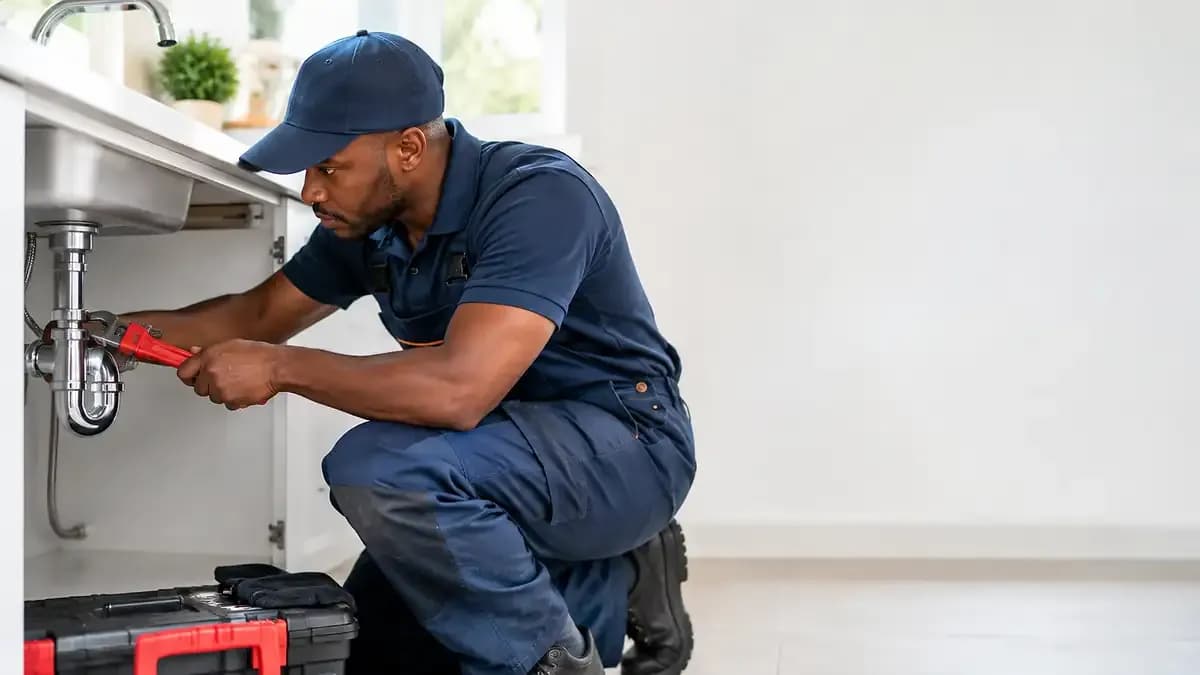
A plumber installs, fixes and tests the pipes that carry water into a building and the drains that carry waste water out. In South Africa that means a lot of geysers, burst pipes, blocked drains and leaking toilets, plus new pipework on building sites. It is hands-on work that keeps people healthy, because clean water and safe drains stop disease.
Plumbing is an official trade in South Africa. To become a qualified plumber you learn at a college and on real job sites, usually through an apprenticeship or learnership with an employer. At the end you write a trade test. If you pass, you get a trade certificate and can call yourself a qualified artisan.
Plumbers work for small plumbing businesses, building companies, municipalities, hospitals and government departments, and many later run their own business. The work is physical and sometimes messy, and emergencies do not wait for office hours. In return you learn a skill every household needs, and you can grow into supervising, inspecting or running a team.
A Day in the Life
Most plumbers in South Africa split their time between call-outs to homes and businesses and planned work on building sites or municipal pipes. No two days are the same, because you go where the water problem is.
Check the job list — The day starts with a list of jobs: a burst geyser, a blocked drain, a new bathroom on a building site. You check you have the right fittings, pipes and tools before you drive out, because a missing part means a second trip.
Replace a burst geyser — Geyser work is the backbone of house plumbing in South Africa. A geyser with a burst tank is usually replaced, not repaired. You drain it, lift it out of the roof space, fit the new one with its safety valves, then test it.
Crawl into the ceiling — Geysers usually sit in the roof space, so you often work bent over in a hot, cramped ceiling, carrying heavy parts and balancing on beams. A calm, careful approach matters here — for your safety and the client's house.
Clear a blocked drain — Blocked drains and sewer lines are everyday work. You use drain rods or a drain machine to find and clear the blockage, then work out why it happened so it does not come back next week.
Find the hidden leak — A high water bill or a damp wall means a leak you cannot see. You test pressure, listen, check the meter and think logically until you find where the water is escaping — often the most satisfying part of the job.
Read the plans on site — On a new building, you read the drawings to see where water pipes, waste pipes, drains and rainwater downpipes must go. Then you measure, cut, join and fix pipes in place, and test them before the walls are closed up.
Save water, save energy — More clients now want solar geysers, heat pumps and water-saving taps, showers and toilets. In water-scarce places like Cape Town, fitting parts that save water is a normal part of the job.
Do the paperwork — You fill in job cards, write up what you did and, if you are a PIRB Licensed Plumber, issue a Plumbing Certificate of Compliance for work like a geyser replacement. Municipal plumbers also fill in log sheets and answer questions from the public.
On standby — Some nights and weekends you are on standby. Burst pipes and geysers do not keep office hours, and municipal plumbers may be called out to water main breaks in any weather.
Choose this career if…
- You are okay with heights or tight spaces
- You do not mind getting dirty
- You like working a problem out logically
- You are careful with detail
- You can be trusted with things that matter
- You are fine working nights, weekends and public holidays
- You stay calm when things go wrong
Qualification
Occupational Certificate: Plumber (apprenticeship or learnership, ending in a trade test)
The main route. You train at a QCTO-accredited provider and work with an employer, then pass the trade test. Last date for new enrolments on this version is 30 December 2026.
Regulated under Skills Development Act 97 of 1998, s26D (trade test) and s17 (learnership agreements), as amended by Skills Development Amendment Act 37 of 2008; Trade Test Regulations, 2014 · Trade Test Regulations: GN R.376, Government Gazette 38758, 8 May 2015. Listed trade '642601 Plumber': GN 691, Government Gazette 35625, 31 August 2012 · (2015)
SAQA ID 91782 · NQF 4 · 360 credits
Artisan Recognition of Prior Learning (ARPL), ending in a trade test
For adults aged 19 or older already doing plumbing work without papers. You need at least three years of provable experience, get assessed, close any gaps, then write the trade test.
Regulated under Skills Development Act 97 of 1998, s26D(2); Criteria and Guidelines for Artisan Recognition of Prior Learning · GN 228, Government Gazette 40691, 17 March 2017 · (2017)
The current plumber qualification is closing to new learners
The current Occupational Certificate: Plumber (SAQA 91782) closes to new learners on 30 December 2026. Learners already enrolled can finish until 30 December 2029. Ask your college which version you will be enrolled on.
Old plumbing certificates are closed to new learners
The older FETC: Plumbing (SAQA 58782) stopped taking new learners on 30 June 2026. If a college offers it to you now, ask questions.
Salary
Then it grows
Artisan Production: Plumber, top of the Grade A–C range (public service)
R424 000
Top of the advertised Grade A to C range; the experience needed to reach it is not stated in the advert
Artisan Foreman: Plumber (public service)
R397 000
Gated at 5 years' experience after qualifying as an artisan
Municipal plumber (Metsimaholo Local Municipality)
R329 000
Trade certificate plus 2 to 3 years' experience after the trade test, and a driver's licence
Artisan Production Grade A: Plumber (public service entry)
R253 000
Trade test certificate (Red Seal) and driver's licence; no further experience required
Qualified plumber, building industry minimum (Cape Peninsula)
R244 000
Trade-tested artisan; legal minimum in the Cape of Good Hope building industry, Area A (40-hour week)
Apprentice, 3rd year (building industry, Cape Peninsula minimum)
R184 000
3rd year of apprenticeship; minimum rate in the Cape of Good Hope building industry only
Apprentice, 2nd year (building industry, Cape Peninsula minimum)
R123 000
2nd year of apprenticeship; minimum rate in the Cape of Good Hope building industry only
Pay depends on who you work for
Government and municipal pay is published, and building-industry bargaining councils publish legal minimums. What private and self-employed plumbers earn above those minimums is not published. The minimums shown here apply to the Cape Peninsula only.
DPSA Public Service Vacancy Circular 22 of 2026, Annexure C (Correctional Services), POST 22/11, as at June 2026 — basic salary before allowances.DPSA Public Service Vacancy Circular 22 of 2026, Annexure C (Correctional Services), POST 22/10, as at June 2026 — basic salary before allowances.Metsimaholo Local Municipality vacancy — Plumber-Sewer, post level 08 (entry of R329k–R381k range) — as_at is the advert's closing date, as at April 2026 — basic salary before allowances.BIBC (Cape of Good Hope) wage schedule, 1 November 2025 — Artisan R117.23/hour × 40 hours × 52 weeks, as at November 2025 — basic salary before allowances.Building Industry Bargaining Council (Cape of Good Hope) Main Collective Agreement 2025–2028 — R88.36/hour × 40 hours × 52 weeks, as at November 2025 — basic salary before allowances.Building Industry Bargaining Council (Cape of Good Hope) Main Collective Agreement 2025–2028 — R58.91/hour × 40 hours × 52 weeks, as at November 2025 — basic salary before allowances.
Matric Requirements
Pass type you need
- Occupational Certificate: Plumber (apprenticeship or learnership, ending in a trade test): Matric not required
- Artisan Recognition of Prior Learning (ARPL), ending in a trade test: Matric not required
Matric helps, even if it is not required
The plumber qualification's official entry rule is a college-level standard, not a matric pass. Many employers still ask for Grade 11 or 12, an N2 or similar, and a driver's licence.
Mathematics or Maths Literacy?
Worth knowingGrade 10 and 11 · still reversible
You take Mathematics
- Mathematics or Technical Mathematics gives you the best start on the Engineering Maths that the plumber qualification's entry standard asks for.
- Pairing it with Physical Sciences or Technical Sciences covers the Science part of that same entry standard.
- Plumbers measure, calculate and read drawings every day, so strong maths makes the work itself easier.
You take Mathematical Literacy
- The plumber qualification's official entry rule asks for a Level 3 standard equal to N2 in Engineering Maths, Science and Building Drawings. It does not name Mathematics or Maths Literacy.
- Maths Literacy on its own does not meet that Engineering Maths standard, so you would need to reach it another way before you start. Ask a TVET college how they handle this.
- The ARPL route for experienced adults has no school-subject rule. It depends on being 19 or older with three years of provable plumbing work.
Best School Subjects
Strongly recommended
- Civil Technology · Its Civil Services specialisation is mostly plumbing: water supply, drainage, sewerage and solar geysers.
- Mathematics · You measure, calculate falls and pressures, and need Engineering Maths at college.
- Technical Mathematics · A practical maths option that builds the Engineering Maths plumbing training needs.
Also useful
- Physical Sciences · Helps you understand water pressure, heat and how geysers work.
- Technical Sciences · Applied science that links directly to trade training.
- Engineering Graphics and Design · Plumbers read building drawings and pipe layouts.
Professional Registration
This career is associated with the Plumbing Industry Registration Board (PIRB).
You register in one of these categories:
- Learner Plumber
- Licensed Plumber
- Master Plumber
- Plumbing Training Assessor
- Qualified Plumber
- Solar Installer
- Technical Assistant Practitioner
Training or supervision is the law
The National Building Regulations say no one may do plumbing work unless they are a trained plumber, or work under the proper control of a trained plumber or an approved competent person. That is why assistants and apprentices work under supervision.
Your city may have its own rules
Cities set water by-laws. In Cape Town and Johannesburg, only qualified plumbers may do certain jobs, like replacing a geyser. In eThekwini (Durban) that work needs registration with the Municipality, and in Cape Town a City-registered plumber must certify a property before it is sold.
Practical Requirements
OtherRequirement
Being 19 or older with at least three years of provable plumbing work experience but no trade qualification. If you already work as a plumber without papers, ARPL lets you prove what you can do. You are assessed on knowledge, practical skills and workplace experience. If you have gaps, you do extra training. Then you write the same trade test as everyone else.
Required by law · Skills Development Act 97 of 1998, s26D(2); ARPL Criteria and Guidelines (GN 228, GG 40691, 17 March 2017)
OtherRequirement
Wanting the artisan qualification for the listed trade Plumber. By law, no one may get an artisan qualification without passing a trade test at an accredited trade test centre. After your training and workplace experience, you write the trade test at an accredited trade test centre. It has a written paper and a practical task over two days. If you pass, the QCTO issues your trade certificate. Learners get three attempts during their contract.
Required by law · Skills Development Act 97 of 1998, s26D; Trade Test Regulations, 2014 (GN R.376, GG 38758, 8 May 2015)
ApprenticeshipApprenticeship
Choosing to become a qualified plumber (artisan) through the Occupational Certificate: Plumber. Plumber is a listed trade, so the artisan qualification needs structured workplace training. You learn in a classroom and a workshop, and on real job sites. You sign an agreement with an employer and an accredited training provider. Of the 360 credits in the qualification, 130 are workplace experience. CETA accredits the providers that teach plumbing, and learners on CETA-funded programmes do not pay for the training.
Required by law · Skills Development Act 97 of 1998, s1 ('learnership includes an apprenticeship') and s17, as amended by Act 37 of 2008
Gas work is a different licence
Being a plumber does not allow you to install or remove gas appliances or gas pipes. By law you must be an 'authorised person' registered with SAQCC Gas, and hand over a certificate of conformity when you finish.
Alternative careers
Related careers. Each has its own entry requirements — check every one separately.
Electrician
Registers with DELAnother building trade with a trade test, but working with power, not water.
Career Ladder
- Plumber's assistant · No qualification required
- Apprentice (learner) plumber · Studying the Occupational Certificate: Plumber · NQF 4
- Qualified plumber (trade-tested artisan) · Occupational Certificate: Plumber + trade certificate · NQF 4
- PIRB Licensed Plumber · Trade certificate + PIRB board assessment · NQF 4
- Artisan Foreman (supervisor) · Trade certificate + 5 years' experience · NQF 4
- Master Plumber or own plumbing business · Licensed Plumber + specialisations + 5 years after qualifying
Last reviewed September 2026. We work hard to keep this information accurate, but details can change — always verify before making a career decision. Tell us something is out of date.

