Career profile · Health
Paramedic
Career summary
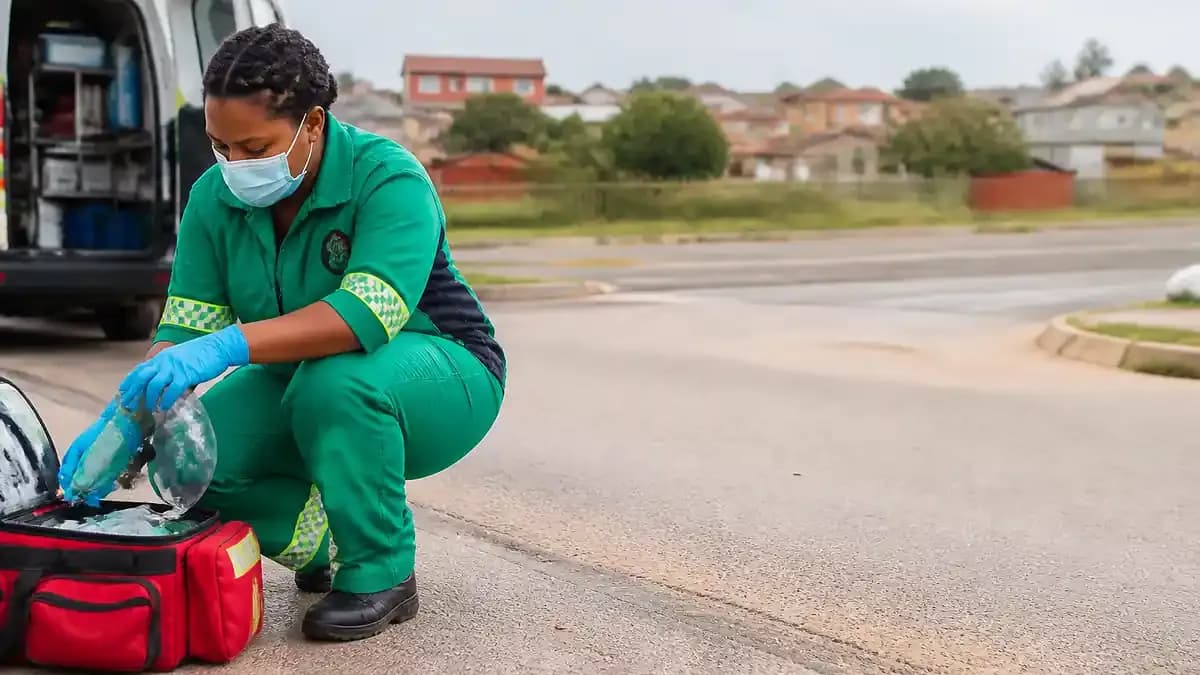
A paramedic is the medical person who comes when you call an ambulance. You treat people at car crashes, shootings, heart attacks and births, often in the street or in a small home. Then you keep the patient stable while the ambulance gets them to the right hospital as safely and quickly as possible.
In South Africa you must be registered with the Health Professions Council of South Africa (HPCSA) to work in emergency care, and students register too. There are three study routes: a one-year Higher Certificate, a two-year Diploma, and a four-year degree. The Higher Certificate leads to the Emergency Care Assistant register and the degree to the Emergency Care Practitioner register. Providers say the Diploma leads to registration as a Paramedic.
Most paramedics work for provincial ambulance services or private ambulance companies. Others work in air rescue, on mines, at big events or in the military. The job means long shifts, nights and weekends, heavy lifting and some frightening scenes. But very few jobs let you see, so directly, that your work kept someone alive.
A Day in the Life
Paramedics work in shifts, not office hours. In provincial services a shift is often 12 hours, day or night, and some services run 24-hour standby shifts. No two shifts are the same.
07:00
Shift change — You take over the ambulance from the night crew. You check the oxygen, drugs, defibrillator and stretcher so that everything works when the first call comes in.
08:30
First call: a car crash — A taxi has hit a pedestrian. You check the scene is safe, find the most badly hurt person first, stop the bleeding, protect the spine and decide which hospital they need.
10:30
Finding the address — In many rural and township areas roads have no names. Control gives you directions by schools or spaza shops, and the drive can take 40 minutes or more on gravel.
12:00
Medical emergency at home — An older man has chest pain. You take his history, check his heart and give him the treatment your register allows, while explaining calmly to a worried family what happens next.
14:00
Hospital handover and paperwork — At casualty you hand the patient over to the doctor, explaining exactly what you found and did. Then you clean the ambulance, restock it and finish the patient report.
16:00
Waiting for an escort — Some areas are red zones, where ambulances have been attacked. You may have to wait for police before you can go in, even though you know someone is hurt nearby.
19:00
Handover to the night crew — You hand the vehicle and any news to the next crew. If a call comes in just before the end of your shift, you may finish late.
Choose this career if…
- You stay calm when things go wrong
- You are not squeamish
- You are fine working nights, weekends and public holidays
- You can handle being around people who are angry or distressed
- You are physically tough
- You are okay with heights or tight spaces
Qualification
- 1year
Higher Certificate in Emergency Medical Care
Registers you as an Emergency Care Assistant
The shortest way in. One year at a university or private provider, leading to work as an Emergency Care Assistant on ambulances. Each provider registers its own SAQA ID.
Regulated under Regulations relating to the qualifications for the registration of emergency care assistants · GN R.733, GG 38008, 16 September 2014
NQF 5 · 120 credits
- 2years
Diploma in Emergency Medical Care
Registers you as a Paramedic
Two years of study, leading to registration as a Paramedic. A 2014 regulation names the Emergency Care Technician register instead. Credits and SAQA IDs differ by provider.
Regulated under Regulations relating to the qualifications for the registration of emergency care technicians · GN R.732, GG 38007, 16 September 2014
NQF 6
- 4years
Bachelor's degree in Emergency Medical Care
Registers you as an Emergency Care Practitioner
A Bachelor's degree that leads to registration as an Emergency Care Practitioner.
Regulated under Regulations relating to the qualifications for the registration of emergency care practitioners · GN R.731, GG 38006, 16 September 2014
NQF 8 · 480 credits
The old short courses have closed
The old short courses (BAA, AEA, CCA and OECO) stopped leading to registration between 2018 and 2020. People already registered through them stay on the register if they keep paying their annual HPCSA fee, but new entrants must complete a Higher Certificate, Diploma or degree.
Strict fitness and medical tests
Providers we checked use selection tests before they accept you, such as a medical exam, a fitness test, a swimming test and a phobia test.
Salary
Then it grows
Emergency Care Practitioner, experienced (Paramedic Grade 4)
R593 000
Gated at 10 years after registration as an Emergency Care Practitioner
Emergency Care Practitioner, starting (Paramedic Grade 3)
R506 000
No experience needed after registration as an Emergency Care Practitioner
No state salary figure for Emergency Care Assistants or the new Diploma
The state job adverts we found don't give a salary for Emergency Care Assistants or for the new two-year Diploma. The salaries shown are for Emergency Care Practitioners. Ask provincial EMS services what they pay.
- DPSA Public Service Vacancy Circular 27 of 2026, Annexure Z (Western Cape Health and Wellness), Post 27/281, as at July 2026 — as advertised by employers.
Matric Requirements
Pass type you need
- Higher Certificate in Emergency Medical Care: National Senior Certificate at Higher Certificate level
- Diploma in Emergency Medical Care: National Senior Certificate at Diploma level
- Bachelor's degree in Emergency Medical Care: National Senior Certificate with a Bachelor’s degree pass
Maths Literacy closes most Diplomas
Most Diploma providers we checked ask for Mathematics; at least one accepts Maths Literacy at level 6. Maths Literacy can still get you into some Higher Certificate programmes and at least one degree, but only with high marks.
Mathematics or Maths Literacy?
Worth knowingGrade 10 and 11 · still reversible
If you are in Grade 10 and want to be a paramedic, stay with Mathematics if you can. It keeps all three study routes open. Keep Physical Sciences and Life Sciences too, and look up the requirements of two or three providers now, so you know the marks to aim for.
You take Mathematics
- All three routes stay open: the Higher Certificate, the Diploma and the Bachelor's degree.
- Every Diploma we checked accepts Maths, if you get the level it asks for (3 or 4).
- You can apply for the degree at more providers, not just the one we found that accepts Maths Literacy, as long as you get the Maths mark they ask for (often level 4).
You take Mathematical Literacy
- Most Diploma programmes close: they ask for Mathematics. At least one accepts Maths Literacy, but only at level 6.
- Some Higher Certificate providers accept Maths Literacy instead of Maths, but usually at a higher level (level 5 or 6). Check each provider's rules.
- Most degree programmes close. At least one accepts Maths Literacy, but only with a high mark (65%).
Best School Subjects
Essential
- English · Home Language or First Additional Language; you write patient reports and hand over to doctors.
Strongly recommended
- Mathematics · Most Diploma and degree programmes require it; it keeps every emergency care route open.
- Physical Sciences · Diploma and degree need both sciences. Many Higher Certificates accept either; some need both. Explains drugs, oxygen and defibrillators.
- Life Sciences · Diploma and degree need both sciences; many Higher Certificates accept either, some need both. Basis for anatomy and physiology.
Professional Registration
Registration with the Health Professions Council of South Africa (HPCSA) is compulsory to practise. Under the Health Professions Act 56 of 1974 (s15 boards; s17 registration required to practise; s18-19 registers/removal; s39 offence to practise unregistered).
hpcsa.co.za— opens in a new tab · 553 Hamilton and Madiba Streets, Arcadia, Pretoria, 0002
You register in one of these categories:
- Emergency Care Assistant
- Emergency Care Practitioner
- Paramedic
Annual fee required to remain on the register; non-payment leads to removal (s19). No amount stated.
Health Professions Council of South Africa— opens in a new tab
Practical Requirements
Possible board exam if you register more than two years after qualifyingRequirement
Applying to any emergency care register more than two years after qualifying In 2017 the HPCSA's emergency care board said that if you register more than two years after qualifying, you must meet certain conditions, such as passing an exam. Register as soon as you qualify to avoid this.
Supervised practical hours over the four-year degree (at least 1,200 at one university)Work-integrated learning
Studying towards the Emergency Care Practitioner register During the degree you work real shifts on ambulances and in hospitals, supervised by qualified staff. One university asks for at least 1,200 supervised hours over the four years.
Professional driving permit (PrDP) to crew a patient-carrying ambulanceClearance or background check
Crewing a patient-carrying ambulance in a public or private emergency medical service (not the SANDF) By law, a licensed ambulance service must make sure both crew members on an ambulance that carries patients hold the right driver's licence for the vehicle and a professional driving permit (PrDP) in the 'Passengers' category.
Required by law · Emergency Medical Services Regulations, 2017 (GN 1320, GG 41287), Annexure A, Personnel (3)(c)
You need a professional driving permit to crew a patient ambulance
Ambulance crews carrying patients need a professional driving permit. Without one, you may struggle to be hired. Get your ordinary driver's licence while you study.
Career Ladder
- Emergency Care Assistant · Higher Certificate in Emergency Medical Care · NQF 5
- Paramedic · Diploma in Emergency Medical Care · NQF 6
- Emergency Care Practitioner · Bachelor's degree in Emergency Medical Care · NQF 8
- EMS Shift Leader · Registration plus operational experience
- EMS Station Manager · Registration plus further management experience
Last reviewed October 2026. We work hard to keep this information accurate, but details can change — always verify before making a career decision. Tell us something is out of date.

