Career profile · Trades
Forklift Driver
Career summary
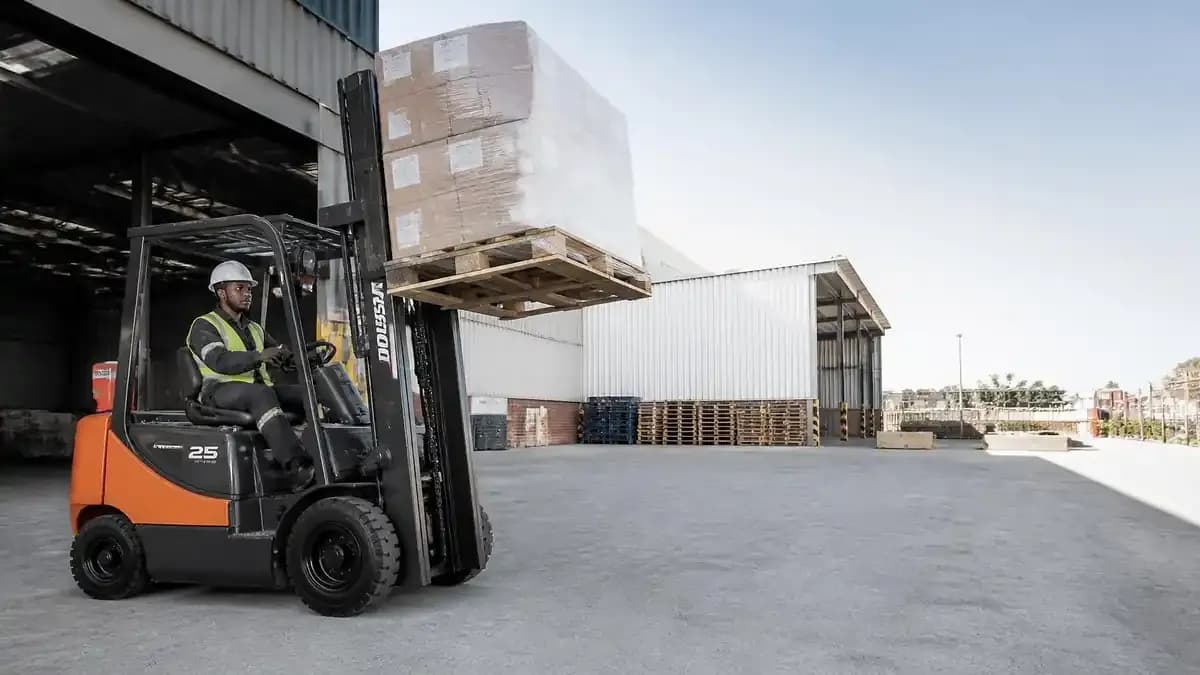
A forklift driver uses a forklift (also called a lift truck) to move heavy goods. You load and offload trucks and containers, stack pallets on high shelves called racking, and move stock around a warehouse, factory, cold store, mine or building-supply yard. Before each shift you check the machine is safe to use.
In South Africa the law says the business in control of the forklift (usually your employer) may only let you drive it if you have been trained for that type of forklift. You do a course with an approved training provider, pass an assessment, and get a certificate plus a licence card. The card must be renewed at least every two years.
This job suits someone careful, calm and reliable, who likes practical work more than classroom work. Shifts, nights, weekends and cold rooms are common. With more forklift types on your licence and some experience, you can move into stock control, supervision and later logistics work.
A Day in the Life
Most of your shift is spent on the machine, moving stock safely and on time. A good day is one where nothing falls and nobody gets hurt.
06:00
Sign out the machine — You collect the forklift key and sign the machine out. You check tyres, forks, chains, brakes, horn, lights and fluid levels, write down what you found, and report any fault before you drive.
07:00
Offloading deliveries — Trucks and containers arrive. You lift pallets off carefully, check them against the delivery paperwork, and take them to the right storage area.
09:30
Stacking the racking — You place pallets on high shelves. You check labels, batch numbers and expiry dates so the oldest stock goes out first. In a cold store you do this in freezing temperatures.
12:00
Scanning and stock counts — You use a hand-held scanner to receive tasks and record where stock goes. Some days you help count stock so the records match the shelves.
14:00
Loading outgoing trucks — Orders must leave on time. You load trucks in the right order, keep loads stable and watch for people walking near the machine.
16:00
End of shift — You check the fuel level or put the battery on charge, clean the machine, park it safely with the forks down, and return the key.
Choose this career if…
- You are careful with detail
- You can be trusted with things that matter
- You stay calm when things go wrong
- You are steady with your hands
- You are fine working nights, weekends and public holidays
- You prefer practical work to sitting in a lecture
- You are physically tough
Salary
Then it grows
National Minimum Wage for a 45-hour week (any industry)
R71 000
Legal floor for most workers; public works (EPWP) workers and learners on a learnership are paid differently. No experience gate
Road freight industry minimum — Mobile hoist operator, grade I (Class B2)
R157 000
No experience gate; the grade comes from the bargaining council's job grading
Road freight industry minimum — Mobile hoist operator, grade II (Class B1)
R130 000
No experience gate; the grade comes from the bargaining council's job grading
The higher minimums apply only in road freight
The road freight minimums bind only employers covered by the road freight bargaining council agreement. There, a forklift lifting up to 6,000 kg is grade II and a bigger one is grade I. A forklift driver at a factory or a shop's own warehouse may fall under a different agreement or only the National Minimum Wage.
SAnews — National Minimum Wage R30.23 an hour from 1 March 2026 (× 45 hours × 52 weeks), as at March 2026 — basic salary before allowances.NBCRFLI — Minimum wage increases, 1 March 2025 to 28 February 2027 (General Freight, Class B2, R3,016.09 a week × 52), as at March 2026 — basic salary before allowances.NBCRFLI — Minimum wage increases, 1 March 2025 to 28 February 2027 (General Freight, Class B1, R2,495.03 a week × 52), as at March 2026 — basic salary before allowances.
Mathematics or Maths Literacy?
Worth knowingGrade 10 and 11 · still reversible
You take Mathematics
- Mathematics keeps every later study option open, including supply chain and logistics qualifications at higher levels.
- It helps if you want to move into stock control or planning, where you work with numbers all day.
You take Mathematical Literacy
- Maths Literacy does not close the forklift route. The law asks for at least Grade 9 (or ABET 4 / NQF 1), not a maths subject.
- We found no forklift operator training that requires Mathematics.
- For later study, such as a higher certificate in supply chain, check each college's entry rules, because some may ask for Mathematics.
Best School Subjects
Strongly recommended
- English · You read safety rules, load charts and delivery paperwork. Home Language or First Additional Language is fine.
Also useful
- Mathematical Literacy · Helps with load weights, stock counts and checking quantities on delivery notes.
Practical Requirements
Medical fitness declaration and eye test before training and before each re-licensingWork-integrated learning
Starting forklift training or re-licensing Before training, you need a medical certificate or an employer declaration saying you are fit. You also need an eye test for day vision, night vision and depth perception. A valid Professional Driving Permit can replace the eye test. You must be at least 18.
Required by law · National Code of Practice for the Training Providers of Lifting Machine Operators, 2024 (Notice 5588 of 2024, GG 51657), clause 12.2, incorporated into the Driven Machinery Regulations, 2015
Forklift operator training and licence card for each forklift type (renewed at least every 24 months)Work-integrated learning
Operating a forklift (lift truck) at work. The duty sits on the forklift's 'user' in law: whoever uses it for their own benefit or has the right to control how it is used, not the operator. The user must make sure only someone trained for that type of forklift operates it. You train with an accredited training provider. If you pass, you get a certificate of competence and a licence card for that forklift type. The card lasts up to 24 months, then you re-license.
Required by law · Driven Machinery Regulations, 2015 (GN R.540), reg 18(11); National Code of Practice for the Training Providers of Lifting Machine Operators, 2024 (Notice 5588 of 2024, GG 51657), clauses 12 and 14
Check the training provider before you pay
Only training from a provider accredited by the QCTO or the Transport SETA, and approved by the Chief Inspector of the Department of Employment and Labour, counts. From the end of June 2027, providers must be accredited by the QCTO. Ask for proof before you pay.
Career Ladder
- General warehouse worker · No formal qualification
- Forklift driver · Certificate of competence and licence card for one forklift type
- Multi-machine operator · Extra forklift types on your licence (reach truck, order picker, very narrow aisle)
- Stock controller or warehouse supervisor · Experience, often with an NQF 3–4 certificate
- Supply chain practitioner · Occupational Certificate: Supply Chain Practitioner (NQF 5; last new enrolments 30 December 2026) · NQF 5
Last reviewed October 2026. We work hard to keep this information accurate, but details can change — always verify before making a career decision. Tell us something is out of date.

