Career profile · Creative
Fashion Designer
Career summary
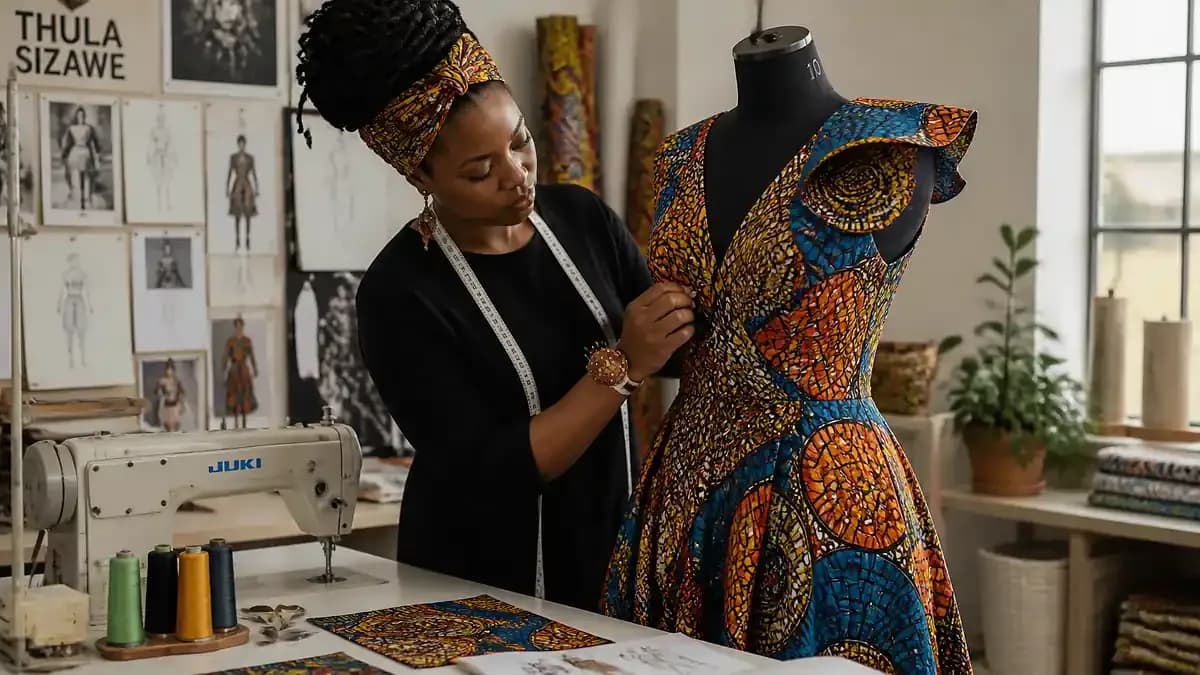
A fashion designer plans clothes and accessories, from the first sketch to the finished garment. You choose fabrics, colours and shapes. You work with pattern makers and seamstresses to turn your ideas into samples. The samples are checked, changed and, if they work, made in larger numbers.
Some designers work in a design team for a retailer or clothing company. Others run their own label, work on contract, or make costumes for film and television. Each season brings new ranges, so deadlines are fixed and the pace can be fast.
We found no law that requires a fashion designer to register or hold a licence. What counts is your skill and your portfolio of work. You can study fashion design at a college or university. A 2024 government list links this job with a bachelor's degree or advanced diploma (NQF level 7), but it does not set job requirements. We found no published pay figure, so ask each employer.
A Day in the Life
No two days look the same. A retail design team works to a season calendar, while an own-label designer is ruled by show dates and orders.
09:00
The studio opens — The seamstress and the rest of the team arrive at an own-label studio. Before a show, a designer may work on three or four samples at once.
Trends, ranges and store visits — In a retail design team you research trends, visit stores to see what sells, and build a range together with buyers and the product team.
Sketches, patterns and sample checks — You sketch ideas, work with pattern makers, and check samples from the factory against your brief. Fit and finish must match what you planned.
The technical pack — You prepare a technical pack: the drawings and details a factory needs to make the garment. Then you hand it over to the production team.
Show week crunch — Before a fashion week show, one Cape Town designer slept about one to two hours a night and stayed in the studio all night the night before show day.
Choose this career if…
- You find new ways of doing things
- You are careful with detail
- You cope well when the plan changes
- You do what you said you would do
- You explain things well
- You are steady with your hands
- You are fine working nights, weekends and public holidays
Qualification
- 1year
Higher Certificate in Fashion
About one year of full-time study. A starter qualification. This SAQA record lists one provider, and other providers may use different SAQA IDs, so check your college's SAQA record.
SAQA ID 112983 · NQF 5 · 120 credits
- 3years
Diploma in Fashion Design and Technology
A three-year diploma with work-integrated learning. SAQA lists one provider, a university of technology. Its 2025 brief asks NSC applicants for no Maths and NCV applicants for 40% in Maths or Maths Literacy.
SAQA ID 100951 · NQF 6 · 360 credits
- 3years
Bachelor of Fashion
A three-year degree. Needs an NSC or NCV with bachelor-degree access, or a Higher Certificate in Fashion.
SAQA ID 123001 · NQF 7 · 360 credits
- 1year
Advanced Diploma in Fashion
About one year of full-time study (120 credits). Builds fashion knowledge and skills, including running your own fashion business. Needs a Diploma in Fashion or an equivalent qualification.
Advanced Diploma · SAQA ID 110040 · NQF 7 · 120 credits
- 1year
Bachelor of Arts Honours in Fashion
A one-year Honours degree. Usually needs an Advanced Diploma in Fashion, a Bachelor of Fashion or a Bachelor of Arts in Fashion Design. Entry through recognition of prior learning is possible.
SAQA ID 122229 · NQF 8 · 120 credits
Check the college and the qualification before you pay
If the college is private, check that it is registered with the Department of Higher Education and Training and that the Council on Higher Education has accredited the programme. Check that the qualification is on SAQA's register.
Qualification rules changed in July 2026
In July 2026 government published a revised framework for higher education qualifications. It replaces the 2013 framework. Some qualification types may be renamed or reshaped over time, so check the SAQA record and ask the college which type your qualification is.
Salary
We found no published pay for fashion designers
No published salary for fashion designers was found on any route. Ask employers directly, and be careful with salary websites that show a single figure.
Matric Requirements
Pass type you need
- Higher Certificate in Fashion: National Senior Certificate at Higher Certificate level
- Diploma in Fashion Design and Technology: National Senior Certificate at Diploma level
- Bachelor of Fashion: National Senior Certificate with a Bachelor’s degree pass
- Advanced Diploma in Fashion: Matric not required
- Bachelor of Arts Honours in Fashion: Matric not required
Check the Maths or Maths Literacy rule at each college
Entry rules differ by college, and not every college asks NSC applicants for a Maths mark. Check the entry page of each college you like.
Mathematics or Maths Literacy?
Worth knowingGrade 10 and 11 · still reversible
This week, start a folder of your own drawings and sewing, because some colleges ask for a portfolio or an entry test. Read the entry page of one or two colleges and note which Maths or Maths Literacy mark they want.
You take Mathematics
- Of the five fashion entry pages we checked, three ask NSC applicants for Mathematics, Maths Literacy or, on one page, Technical Mathematics. The other two ask for neither.
- None of the five asks NSC applicants for Mathematics specifically. One asks it of old Senior Certificate holders.
- This page covers fashion programmes only. Check other careers separately before you drop Mathematics.
You take Mathematical Literacy
- Of the five pages we checked, three accept Maths Literacy in place of Mathematics for NSC applicants, at a higher mark or level. Of the other two, one only recommends it.
- Entry rules differ by college, so check the exact mark on each entry page.
- We did not check routes outside fashion, so do not assume other careers stay open.
Best School Subjects
Essential
- English · If your college teaches in English, NSC holders need at least 30% in it. Colleges can ask for more.
Strongly recommended
- Visual Arts · Drawing and design thinking are what portfolios and entry tests look at.
- Design · Covers the design process.
Also useful
- Consumer Studies · Covers fibres, fabrics and clothing.
- Engineering Graphics and Design · Teaches technical drawing that must be accurate and neat, by hand or on computer.
- Computer Applications Technology · Designers draw on computers with programs such as Adobe Illustrator and Photoshop.
Practical Requirements
Work-integrated learning in the Diploma in Fashion Design and Technology (two modules, 60 credits in the record)Internship
The rules of the qualification you enrol in. There is no register for fashion designers, so no register category triggers it. This diploma's SAQA record includes work-integrated learning: two modules, one of 20 credits at NQF level 5 and one of 40 credits at NQF level 6. The record does not say how long it lasts. We found no law that makes this compulsory for fashion designers. It comes from the qualification's own rules.
Simulated work-integrated learning in the Higher Certificate in Fashion (one 10-credit module in the record)Internship
The rules of the qualification you enrol in. There is no register for fashion designers, so no register category triggers it. The SAQA record for the Higher Certificate in Fashion lists one simulated work-integrated learning module of 10 credits. We found no law that makes this compulsory for fashion designers. It comes from the qualification's own rules.
Career Ladder
- Intern or assistant designer · A bachelor's degree or advanced diploma (NQF 7), the level on the DHET list · NQF 7
- Junior or in-house designer · Bachelor's degree or advanced diploma (NQF 7), the level on the DHET list · NQF 7
- Senior designer · Same level on the DHET list: bachelor's degree or advanced diploma (NQF 7) · NQF 7
- Head designer or own-label owner · Same level on the DHET list: bachelor's degree or advanced diploma (NQF 7) · NQF 7
Last reviewed November 2026. We work hard to keep this information accurate, but details can change — always verify before making a career decision. Tell us something is out of date.

