Career profile · Agriculture
Botanist
Career summary
A botanist studies plants. You find them in the veld, name them, and work out how they live and which ones are in danger. Some botanists work in herbariums, where dried plant specimens are kept for study. Others work in labs, in conservation areas, or for firms that need to know what grows on a piece of land.
Botanists work for state bodies, universities and environmental firms. Field trips can take you to very remote places, so you must be happy outdoors and away from home. You also spend time at a desk, writing reports, entering data and answering questions about plants. Your postgraduate research shapes the plants and places you work with.
Scientist posts usually need a science degree, which asks for school Mathematics. Many science degrees also ask for Physical Sciences. SACNASP, the council for natural scientists, says all practising natural scientists must register. Some posts demand registration. A Candidate or Certificated Natural Scientist may only work under the supervision of a Professional Natural Scientist. Permanent posts can be hard to get, so good marks, experience and patience all matter.
A Day in the Life
This is an example field-trip day. Herbarium, lab and office days look different, and your day depends on your employer.
Pack and plan — You sign out the equipment, load the plant presses and check that you have written permission from the landowner, plus any permit you need. You also pack a first aid kit, water and a hat.
Into the veld — You drive to a remote site and walk for hours, looking for the plant species you came for. You note where each plant grows and record details, such as how many there are and what threatens them.
Collect and record — You collect a sample of the plant, photograph it and write down the exact place. Then you put it in a plant press, so it can be dried and kept as a specimen.
Back at camp — You check the presses, write up your notes and plan the next day. Heat, cold and dust are part of the job, and remote sites can be far from town.
Back at the herbarium — After the trip, the specimens go into dryers. Then they are identified, mounted and filed in the herbarium. SANBI's own procedure asks staff to process the material within a month of getting back.
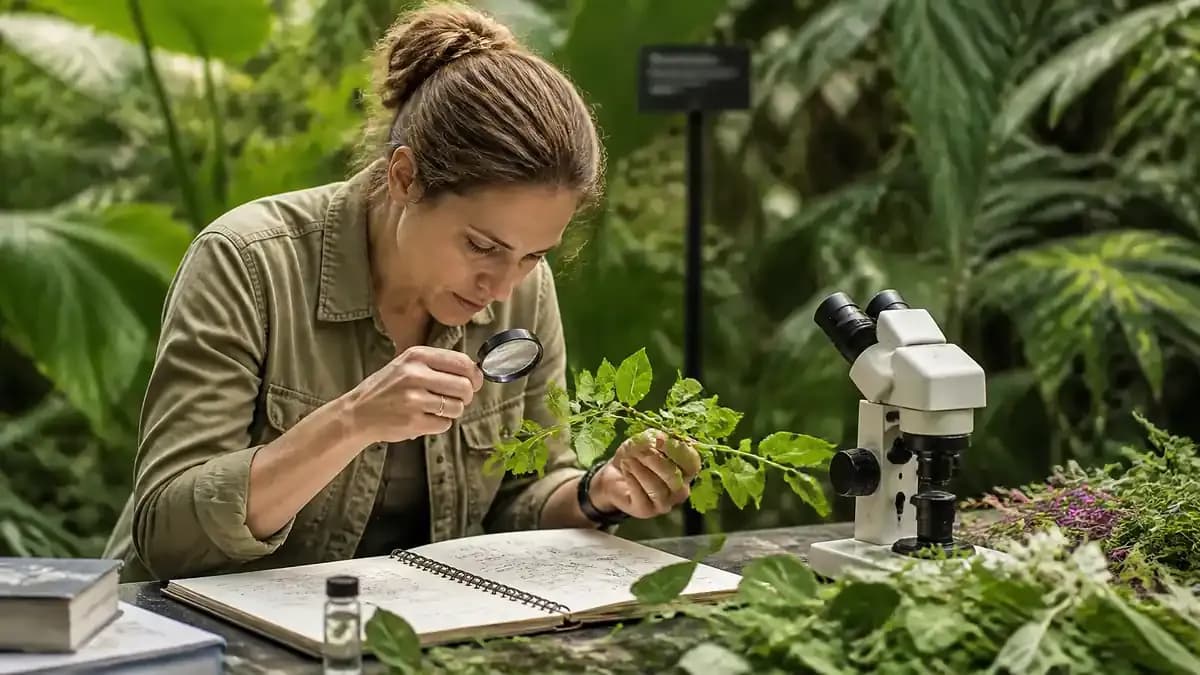
At the microscope — To name a plant you may need to look at its tiny parts under a microscope and compare it with other species. This careful work is how botanists tell look-alike plants apart.
At the desk — You write reports, enter data and answer plant-identification questions from researchers and the police. Some days are spent at a desk instead of outdoors.
Mathematics or Maths Literacy?
Decide nowGrade 10 and 11 · still reversible
Choose Mathematics, not Maths Literacy, if you want a botany degree. If you are in Grade 10 or 11 on Maths Literacy, ask your school about switching now. Check the entry rules of the course you like.
You take Mathematics
- The botany and plant science degree routes stay open, and with them Honours, Master's and PhD later.
- The usual road to scientist posts and Professional registration with SACNASP stays open.
- Diploma routes in horticulture and nature conservation also stay open.
- Technician and technical assistant posts stay open.
You take Mathematical Literacy
- The science degree route closes. The science faculties we checked ask for Mathematics, and some say outright that Maths Literacy is not accepted.
- That makes the usual road to Honours, Master's and PhD, and to scientist posts and Professional registration, much harder. Other roads exist, such as a three-year diploma in a natural science field, which SACNASP lists for Certificated registration, but they are harder and mean working under a Professional's supervision.
- Some diploma courses in horticulture and nature conservation accept Maths Literacy, so a plant-related career stays possible.
- A SANBI principal technical assistant post we checked (2023) asked for Grade 12 with Biology and a job-specific qualification, with 5 years' experience, or a National Diploma or Higher Certificate with 3 years. A higher qualification at NQF 7, such as an Advanced Diploma, was only an added advantage.
Best School Subjects
Essential
- Mathematics · The degree courses we checked ask for Mathematics. Some say Maths Literacy is not accepted.
- English · Science degrees ask for an English mark, and reports and papers are written in English.
Strongly recommended
- Physical Sciences · Many science degrees ask for it, so check the entry rules of the course you like.
- Life Sciences · Some degrees and diplomas ask for it, and it is the school subject closest to botany.
Professional Registration
Registration with the South African Council for Natural Scientific Professions (SACNASP) is compulsory to practise. Under the Natural Scientific Professions Act 27 of 2003.
sacnasp.org.za— opens in a new tab · Suite L1 – L5, Enterprise Building, The Innovation Hub, Pretoria, 0087
You register in one of these categories:
- Certificated Natural Scientist
- Professional Natural Scientist
2026/27 annual fees, effective 1 April 2026: Professional R1,920; Certificated R1,210; Candidate R610; Pensioners R370. There is also an application fee and an upgrade fee. Section 18(2) says you may not practise in a Schedule I field unless registered. Candidate and Certificated scientists must work under a Professional.
South African Council for Natural Scientific Professions— opens in a new tab
What the law says about registration
The Act says nobody may practise in a field like Botanical Science unless registered. SACNASP says all practising natural scientists must register, but the Act does not define practising. Only a registered person may be a consultant or use the protected titles. A draft law to replace the Act was published for comment in March 2026.
Career Ladder
- Herbarium technical assistant · Grade 12 with Biology, a job-specific qualification and 5 years' experience (a 2023 SANBI advert) · NQF 4
- Technician or intern · Three-year degree or diploma in botany or horticulture · NQF 6
- Scientist (botanist) · Honours or Master's degree in botany, plus two to three years' experience · NQF 8
Many scientist posts ask for a Master's
Most SANBI scientist adverts we checked from 2018 to 2024 asked for a Master's. Two adverts in 2019 asked for an Honours degree, and one of those also accepted an MSc. Plan for postgraduate study if you want a scientist post, and start with good marks.
Last reviewed November 2026. We work hard to keep this information accurate, but details can change — always verify before making a career decision. Tell us something is out of date.

