Career profile · Trades
Barber
Career summary
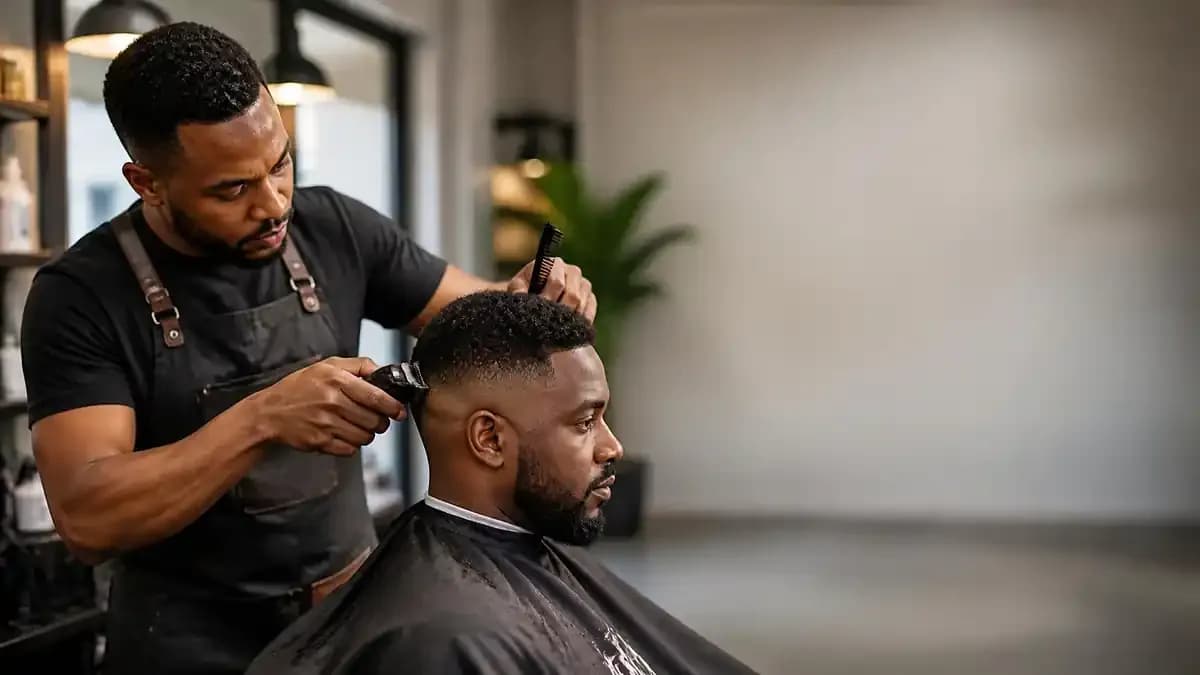
A barber cuts and shapes hair and beards. Most clients are men and boys. You do clipper cuts, fades, line-ups, beard trims and razor shaves. A good barber is fast, neat and careful, because every cut sits right on someone's head.
In South Africa barbers work in big chain barbershops, small neighbourhood shops, shipping-container shops in townships and tented stalls near taxi ranks. Many people learn by working next to an experienced barber. You do not need a personal licence to be a barber, though your city may want a permit if you run your own shop or stall. Short formal training exists, and a full three-year hairdressing qualification is another option if you want a trade certificate.
The job is hard on your body. You stand all day, often into the evening, and Saturdays and December are the busiest times. Money can go up and down, especially if you work for yourself. But barbershops are community spaces, regular clients become friends, and once you have the skill you can open your own shop.
A Day in the Life
A barber's day is a steady stream of short jobs, each one about 30 to 40 minutes, with the biggest rush after work, on Saturdays and in December.
06:00
Setting up a street stall — A street barber puts up the tent, chair and mirror before the morning commuters arrive, and connects a charged battery so the clippers can run all day without a plug.
08:30
Cleaning and checking bookings — In a barbershop, the morning starts with disinfecting clippers, blades and combs, laying out clean towels and checking who has booked online. Walk-in clients start arriving as soon as the door opens.
10:00
Fades, line-ups and beard shaves — Most of the day is cut after cut: skin fades, sharp line-ups, beard trims and hot-towel razor shaves. Each one needs a steady hand and a clean tool, and a chat with the person in the chair.
12:30
When the power goes off — A power cut in the middle of a fade means switching to cordless clippers, starting a generator, or losing a client who travelled to see you. Keeping batteries charged is part of the job.
14:00
Marketing your work — Many barbers film a finished cut and post it online to bring in new clients. Your own work is your advert, so a good photo of a clean fade can fill tomorrow's bookings.
17:00
The after-work rush — People come straight from work or school, so late afternoon is often the busiest time. Street stalls pack up around sunset, while some shops stay open until eight at night.
Saturdays and December — Saturdays are the longest days, and many shops also open on Sundays and public holidays. December, before the festive season, is one of the busiest times of the whole year.
20:00
Closing up safely — Tools are cleaned and disinfected, the floor is swept, money is counted and expensive clippers are locked away or taken home, because theft is a real risk.
Choose this career if…
- You are steady with your hands
- You are fine on your feet all day
- You are fine working nights, weekends and public holidays
- You are careful with detail
- You genuinely like people
- You do not wait to be told
- You prefer practical work to sitting in a lecture
Qualification
Skills Programme: Barber (SP-191215)
A short, barber-only skills programme, not a full qualification. Services SETA funds it for people who already work in a barbershop, through their employer, an industry association, a union or a training provider.
NQF 3 · 36 credits
- 3years
Occupational Certificate: Hairdresser
The full trade route. Three years at a public TVET college plus salon work, ending in a trade test. It covers men's hairdressing but is broader than barbering alone.
SAQA ID 102497 · NQF 4 · 540 credits
There is no full barber qualification
The only barber-specific course we found on official lists is a short skills programme. The full trade route is the Hairdresser certificate. SAQA says it includes the old 'Gentleman's Hairdressing' trade, but it is a general hairdressing course, not a barbering one.
Check the Hairdresser certificate is still open
SAQA's record shows this qualification's registration ended on 30 December 2025. New learners can still enrol until 30 December 2026. Ask a TVET college whether it has been renewed or replaced before you apply.
Matric Requirements
Pass type you need
- Occupational Certificate: Hairdresser: Matric not required
Best School Subjects
Also useful
- English First Additional Language · Talking to clients, reading product labels and marketing yourself online.
- Business Studies · Many barbers end up running their own shop and managing money, stock and staff.
- Mathematics · Pricing, cashing up and keeping track of income, though no Grade 12 maths is required.
Practical Requirements
Hairdresser trade testRequirement
Finishing the Occupational Certificate: Hairdresser. Working as a barber does not legally require this test. The course ends with a trade test, run under the Skills Development Act. Barbering itself has no separate trade test.
Required by law · Skills Development Act 97 of 1998, section 26D
Hairdresser apprenticeship: at least two days a week in a salonApprenticeship
Enrolling for the Occupational Certificate: Hairdresser. There is no register for barbers, and working as a barber does not legally require this training. Learners split their time between a TVET college and a real salon, spending at least two days a week in an approved workplace.
In Johannesburg, hygiene rules apply in every barbershop
Johannesburg's public health by-law says anyone working in a salon must disinfect razors, blades, scissors and clippers after each use, wash their hands before and after each client, and keep sharp tools in a sharps box.
Dirty tools can spread infection
A 2018 study of 50 barbers in Cape Town townships found blood on 42% of clippers and hepatitis B on 8%. Most barbers wiped their clippers with methylated spirits, which the researchers say does not kill viruses. Proper disinfecting protects you and your clients.
Alternative careers
Related careers. Each has its own entry requirements — check every one separately.
Hairdresser
Adds colouring, relaxing and styling; has a full three-year trade qualification.
Career Ladder
- Trainee Barber · No qualification needed. Your first six months, learning in a shop (bargaining council grade); optional Skills Programme: Barber (SP-191215)
- Junior Barber · Six months to a year of experience (bargaining council grade)
- Senior Barber · More than a year of experience (bargaining council grade) and a steady client list
- Barbershop Owner · Experience, savings and business skills; in some cities, a permit or licence for the shop
- Barber Trainer / Educator · Years of experience; teaching in a shop or training academy
Barber is not a trade on its own
The government's official list of trades includes Hairdresser but not Barber. So there is no barber trade test. A barber who wants artisan status takes the hairdressing trade test.
We work hard to keep this information accurate, but details can change — always verify before making a career decision. Tell us something is out of date.